

October 18, 2026 · Biweekly · Coverage window: 2026-09-28 to 2026-10-18
Highlights
- Frankfurt underdelivered on Las Vegas’s promise: the vSphere Standard comeback got no concrete details at Explore on Tour Frankfurt, and the community mood shifted from anticipation to skepticism.
- Talos steps onto the virtualization main stage: TalosCon 2026 featured a public alpha demo of Talos Hypervisor; together with Talos Director (announced Sept 30), the “immutable OS + KVM + single API” VMware-alternative narrative is now complete.
- A busy release window: QEMU 11.1.2, OpenStack 2026.2 “Hibiscus”, KubeVirt v1.9.1, libvirt 12.8.0, Talos 1.14.3/1.14.4, Harvester v1.9.1-rc3.
- One retirement, two security advisories, one lookahead: Azure NVv4 retired; Xen XSA-520 plus a desktop-hypervisor patching reminder; KVM Forum 2026 schedule is live.
- ZSvirt enters third-party view: veteran virtualization blogger Vladan Seget published a hands-on ZSvirt review; the official team released a long-form ZSvirt vs Proxmox VE 9 comparison answering the community’s most-asked question.
1. Headlines: VMware Explore Frankfurt and TalosCon 2026
VMware Explore on Tour Frankfurt (Oct 13–14): the vSphere Standard comeback that wasn’t (yet)
VMware Explore on Tour’s European stop ran October 13–14 in Frankfurt. The biggest pre-event question was whether Broadcom would finally detail the return of vSphere Standard.
The story began at the flagship VMware Explore in Las Vegas: on September 2, Ram Velaga (President, Infrastructure Software Group) and Paul Turner (CPO, VCF Division) told The Register in an interview that an updated vSphere Standard is coming. The entry-level virtualization bundle has not had a substantial release since vSphere 8 in 2022, and no Standard edition accompanied vSphere 9 / VCF 9 in 2025. Turner acknowledged that sales incentives had skewed too heavily toward the full VCF bundle (“We corrected this”) and hinted more details would arrive at the Frankfurt tour stop.
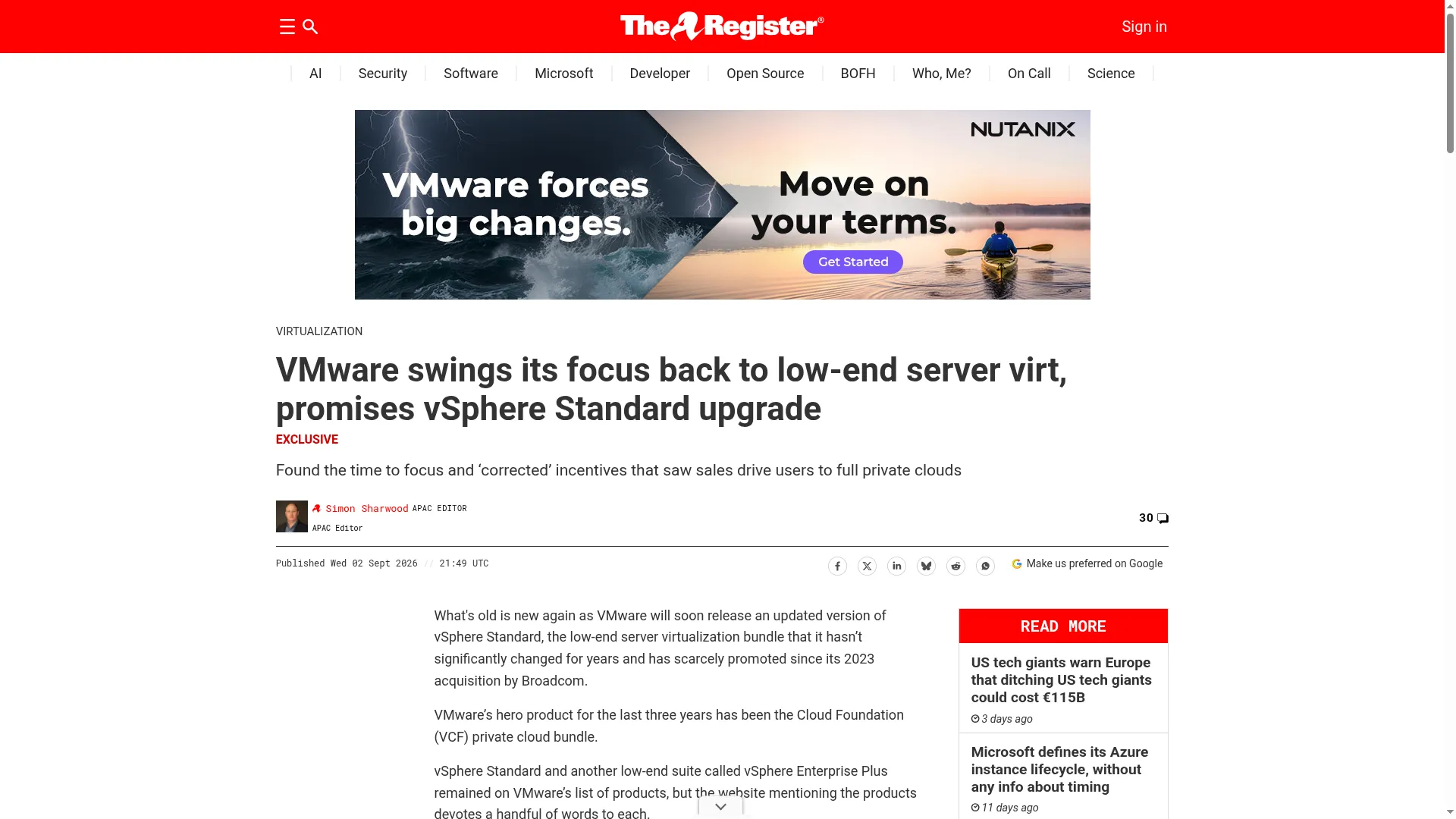 ▲ The Register’s exclusive interview: VMware will update vSphere Standard and has “corrected” the incentives that pushed customers toward VCF (source screenshot, as below)
After Frankfurt, attendee feedback was remarkably consistent: no pricing, no core-count cap, no GA date for vSphere Standard. In a community thread, one attendee wrote that they “hoped to hear some news about vSphere Standard 9” and now suspected “this was a hoax”; another noted that what was actually discussed on site was a VVF (VMware vSphere Foundation) bundle with NSX, with Standard mentioned only informally as something for a limited-core-count small-market tier. The same thread describes visibly lower attendance — “the rooms weren’t as full” — explicitly linked to pricing policy.
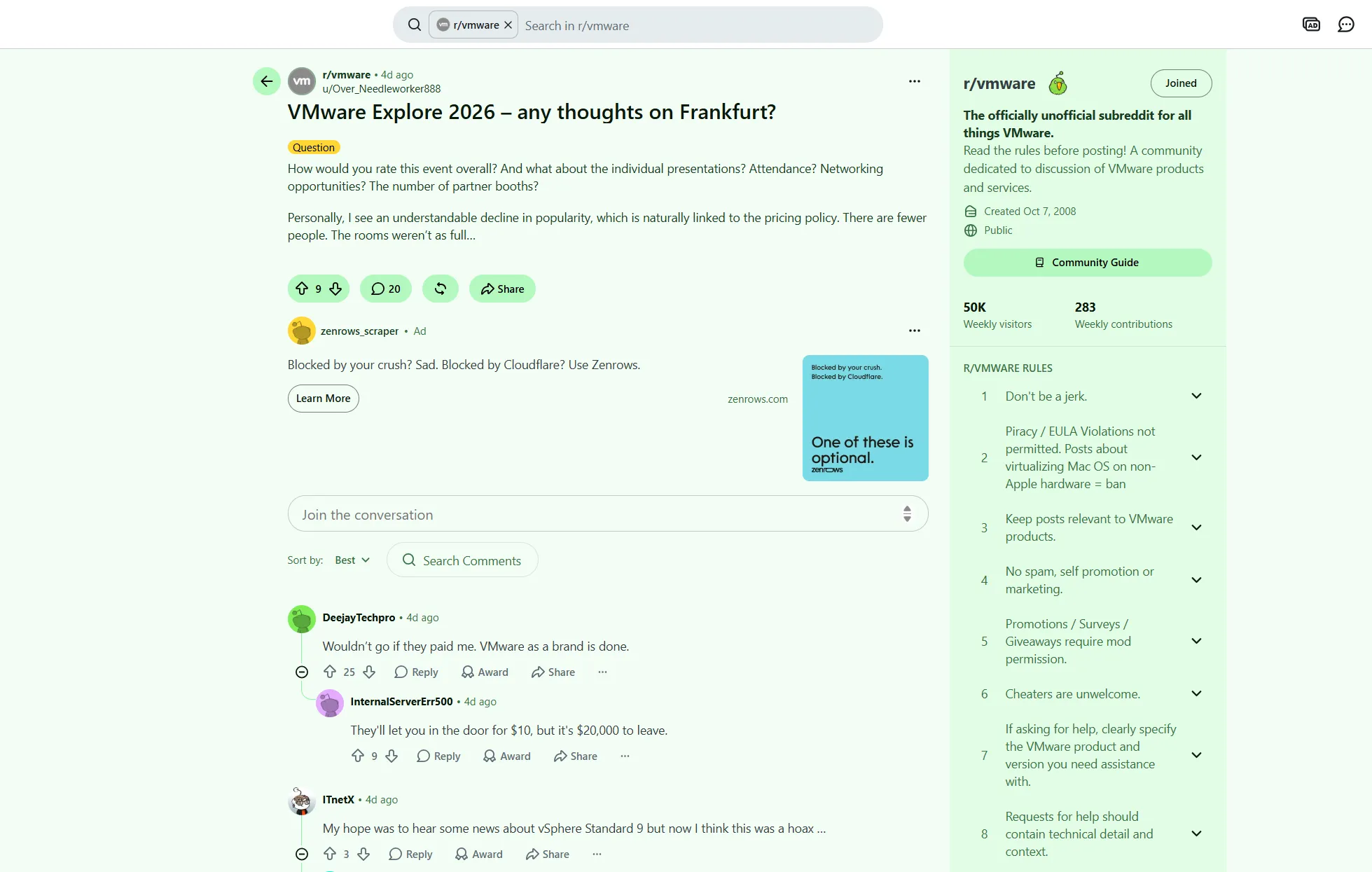 ▲ Attendee thread: no vSphere Standard 9 details at Frankfurt; only VVF+NSX bundle news (screenshot contributed by our community editor)
Context worth noting: on October 7, heise online reported a Rimini Street survey in which 90% of polled IT decision-makers are considering leaving VMware/Broadcom over licensing costs; roughly 54% cited the October 11, 2027 End of General Support for vSphere 8 as a direct driver. Moving to vSphere 9 today requires subscribing to VVF or the full VCF stack.
Editor’s take: the vSphere Standard return remains at the “executive interview preview” stage — no keynote, no press release, no blog post, and Frankfurt delivered no specifics. For a product line whose effective discontinuation already pushed thousands of customers into migration projects, this style of comeback itself erodes trust. Next checkpoints: Explore on Tour Tokyo (Oct 20–21) and London (Nov 18–19).
TalosCon 2026 Amsterdam (Oct 15–16): Talos Hypervisor goes public alpha
Almost back-to-back with Frankfurt, Sidero Labs held TalosCon 2026 on October 15–16 at Hotel Okura, Amsterdam, themed around “the framework for your sovereign cloud and AI strategy” — two days, 30+ speakers, with production stories from Nokia, PostFinance, DHL and others.
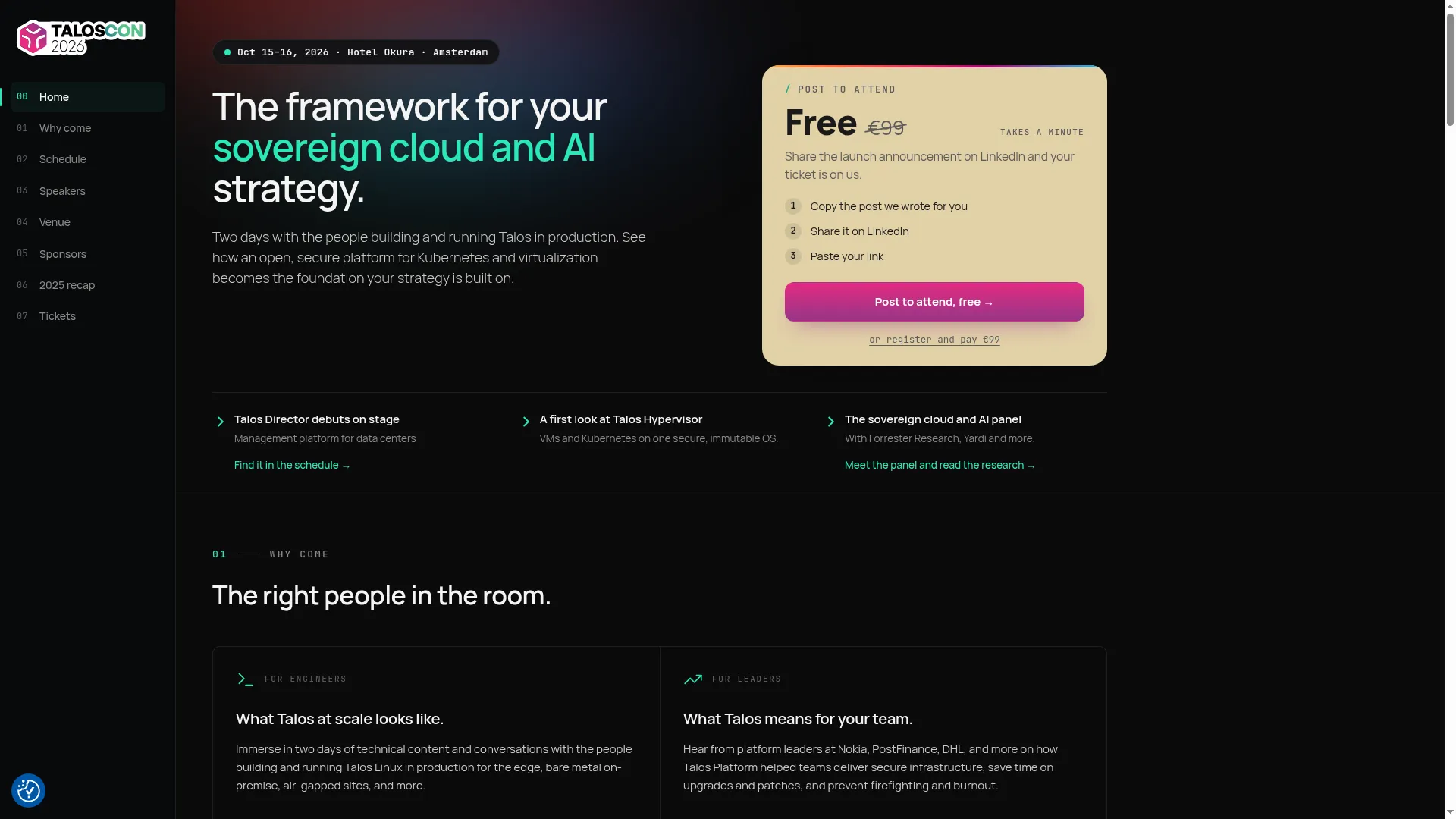 ▲ TalosCon 2026: October 15–16, Amsterdam; highlights include the on-stage debut of Talos Director and a first look at Talos Hypervisor
The centerpiece was a public alpha demo of Talos Hypervisor: native KVM virtualization built directly into Talos Linux (enabled via system extensions from the Talos Image Factory, with libvirt), without KubeVirt and without a general-purpose host OS. One immutable, shell-less, SSH-free, API-driven machine runs VMs, OCI containers and Kubernetes clusters side by side. It is open source (MPL-2.0) with GA targeted for December 2026; an Enterprise mode (Talos Enterprise Linux for Hypervisor) adds CVE SLAs, schematic-specific SBOMs/curated VEX, FIPS 140-3 builds and commercial IP indemnity.
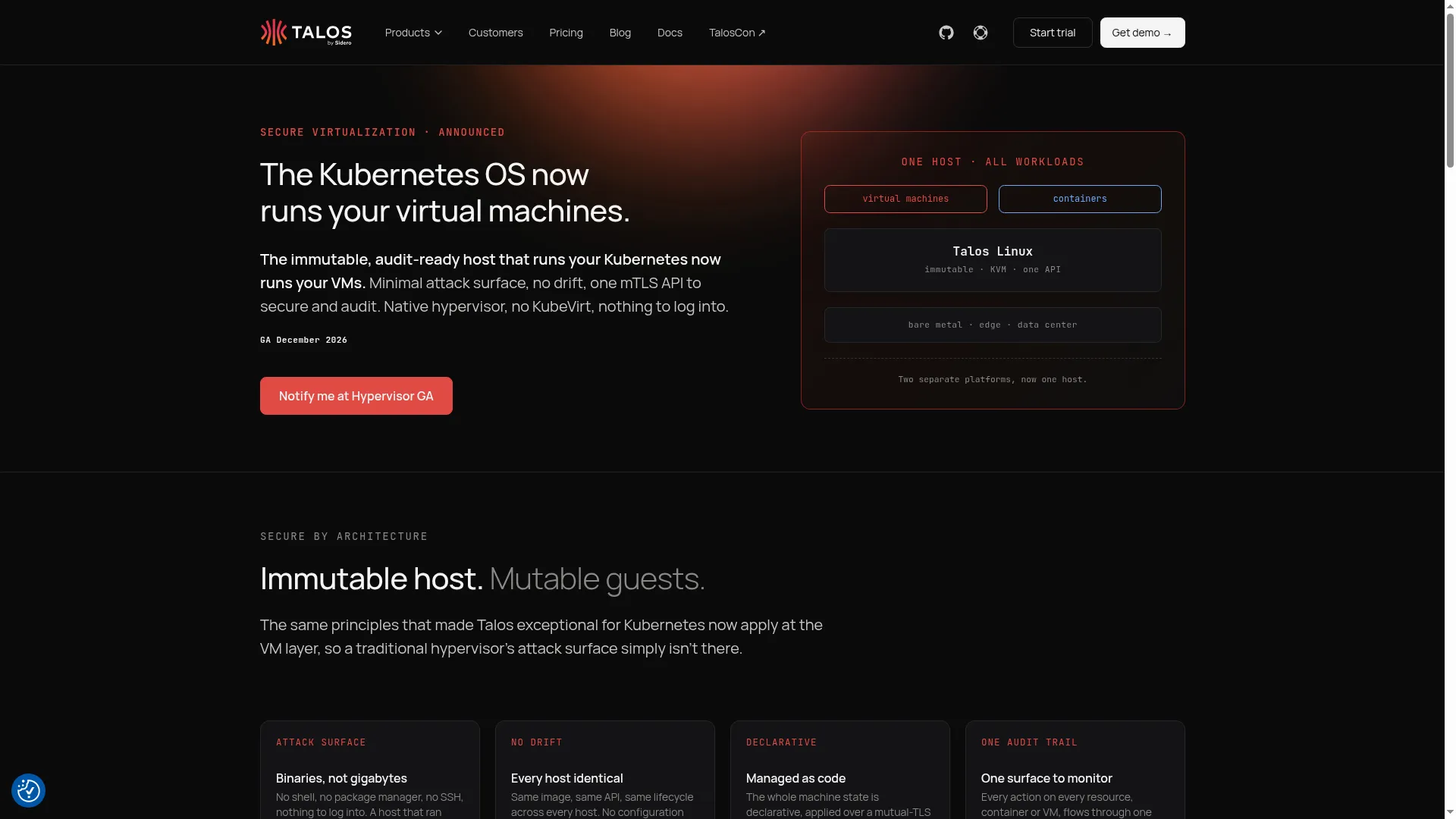 ▲ “The Kubernetes OS now runs your virtual machines”: native KVM, no KubeVirt, GA December 2026
Its companion piece is Talos Director, announced September 30 and debuted on stage at the conference — a data-center resource manager positioned as a VMware vCenter alternative, covering VM and Kubernetes cluster lifecycle, live migration, HA, snapshots, resource pools and micro-segmentation, and absorbing Omni’s fleet-management capabilities. Sidero disclosed that its parent company Yardi (which acquired Sidero Labs earlier this year) has migrated thousands of VMs and hundreds of Kubernetes clusters from VMware to Talos Director, “without any platform reengineering.”
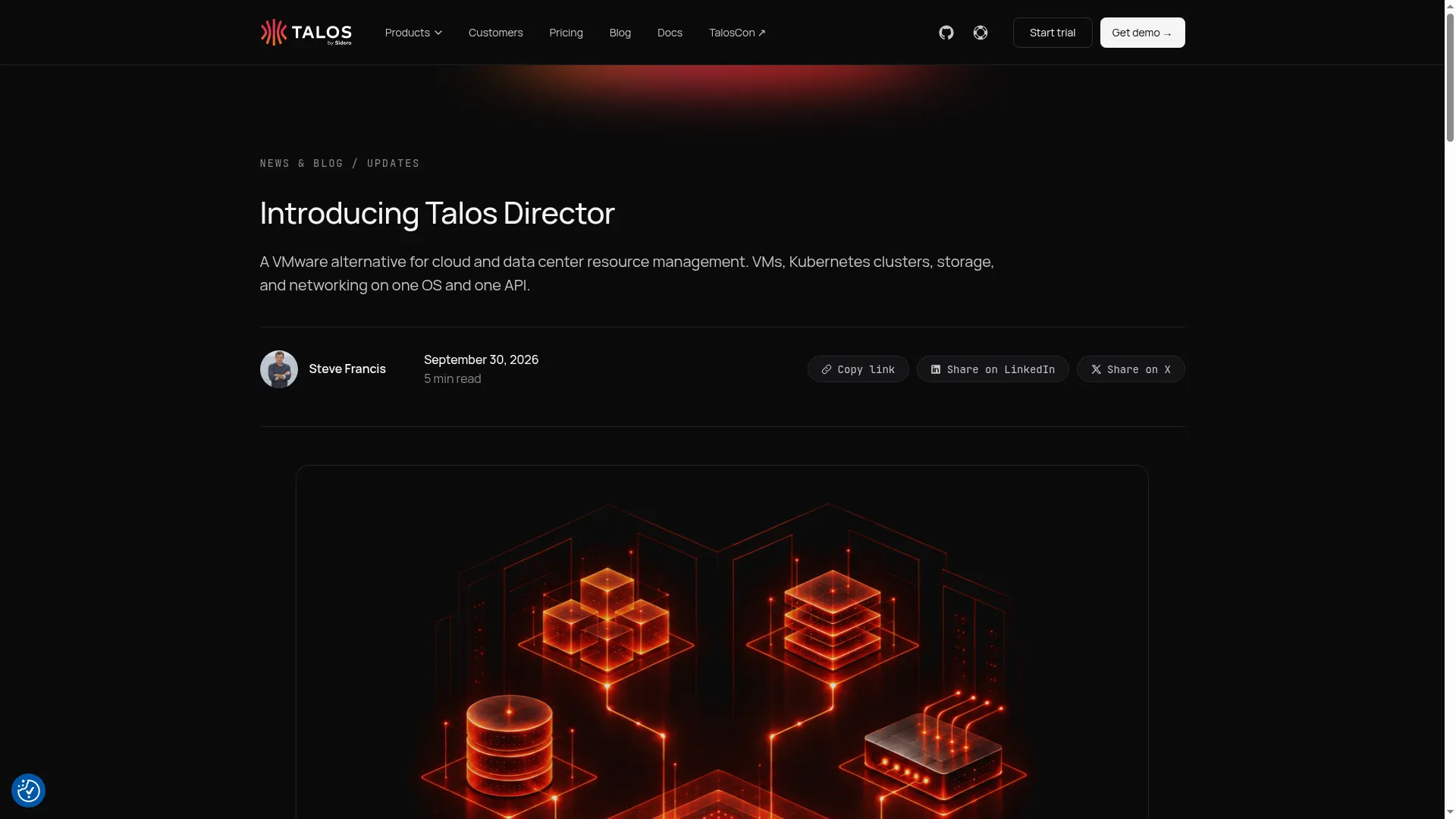 ▲ “Introducing Talos Director”: a data-center resource manager built on Talos Linux for Hypervisor
During the conference Sidero also shipped Talos 1.14.3 (10/15) and 1.14.4 (10/16) — the latter on Linux kernel 6.18.57 with Kubernetes 1.37.1 images — while v1.15.0-alpha.1 landed on October 13.
Editor’s take: on one side, Broadcom offers a “preview of a preview”; on the other, Talos puts a live alpha demo on stage with a named GA month. For teams evaluating VMware alternatives, the “immutable host + declarative API” route now has a complete storyline: Hypervisor (compute) → Director (management plane) → Omni (fleet). Whether the December GA lands on time is our top watch item for the next issue.
2. Releases
QEMU 11.1.2 (Sept 28)
The QEMU project released 11.1.2 on September 28, alongside maintenance updates 11.0.5 and 10.0.14 the same day. Source tarballs (with GPG signatures) are on download.qemu.org; see the wiki ChangeLog/11.1 for details.
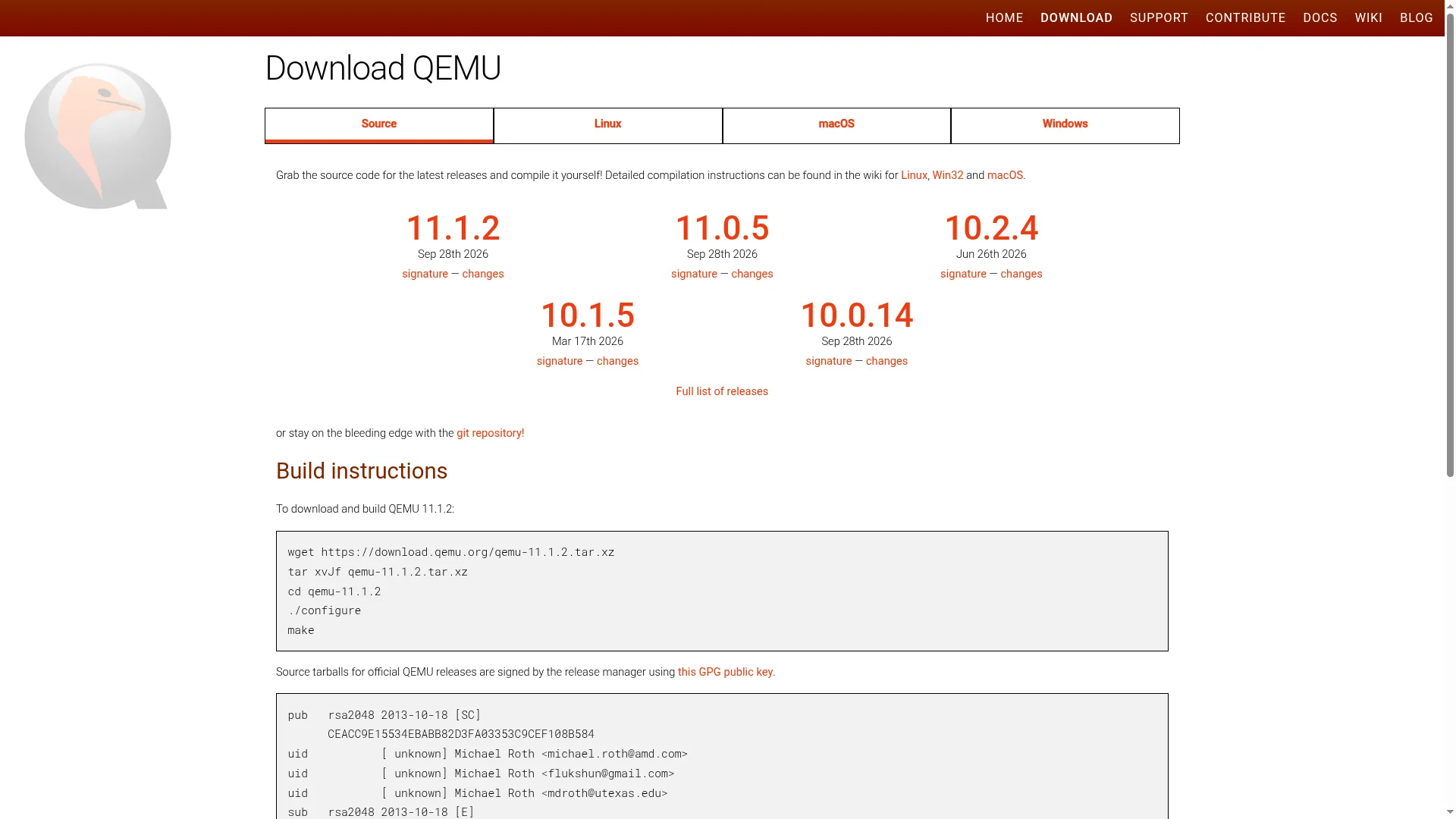 ▲ qemu.org: 11.1.2 released September 28, 2026
OpenStack 2026.2 “Hibiscus” (Sept 30)
OpenStack’s 34th release, 2026.2 “Hibiscus”, shipped on September 30 under the banner of “trusted infrastructure for the AI era”:
- Around 600 contributors this cycle (+21% vs 2026.1 Gazpacho), landing 11,500 code changes (+28% release over release), with the OpenDev Zuul CI running roughly 1.6 million jobs;
- Nova expands confidential computing with AMD SEV-SNP and Intel TDX hardware-backed memory encryption and attestation;
- Nova and Cyborg can now manage mediated devices such as vGPUs; Manila adds Weka and Lustre parallel filesystem support for AI/HPC workloads;
- Neutron cuts the memory footprint of HA router monitoring by more than 15x; Watcher improves utilization; Glance gains parallel image imports;
- Designate hardens DNS security (TLSA/DANE support and post-quantum preparation tooling).
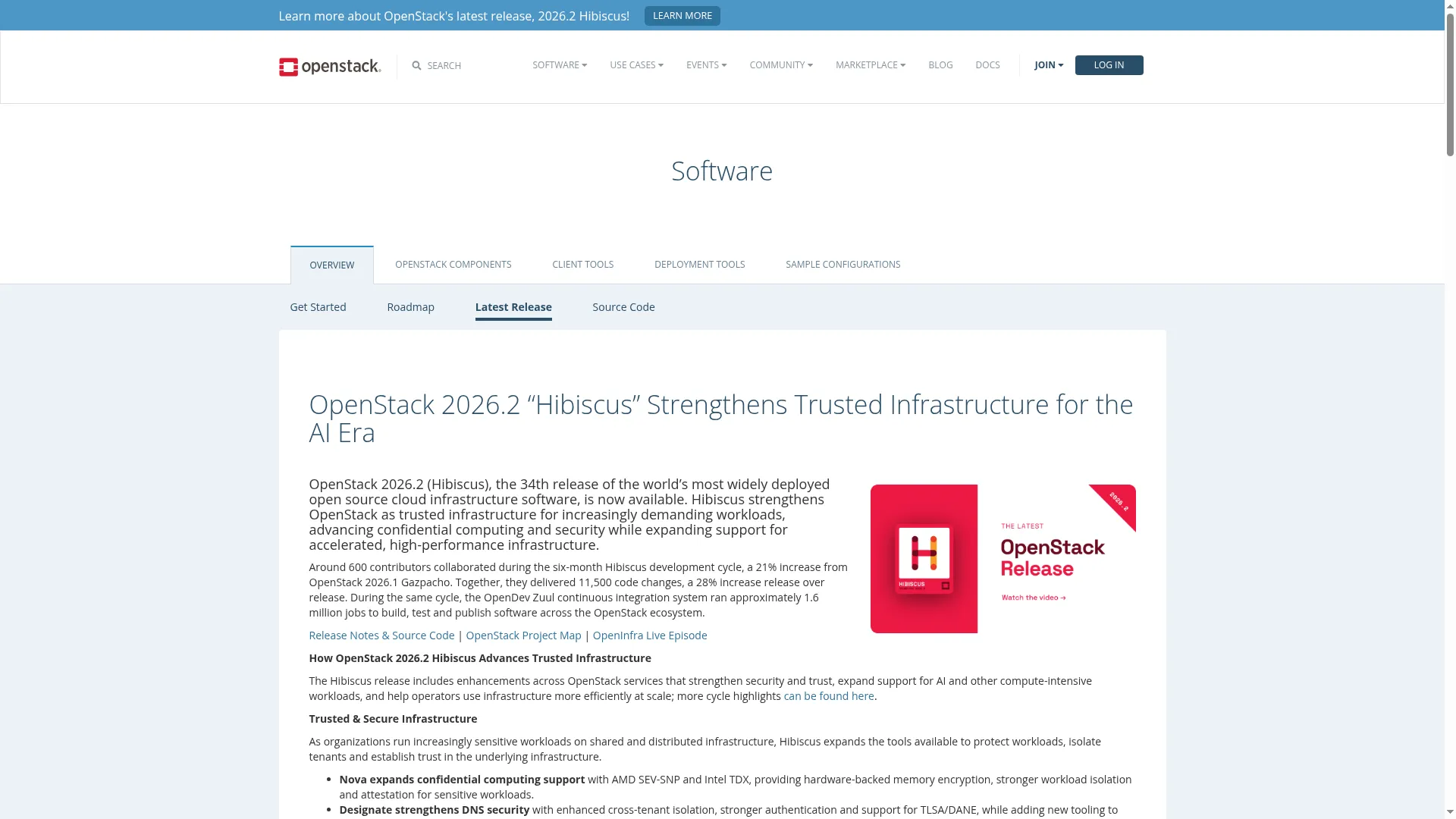 ▲ openstack.org: 2026.2 “Hibiscus”, the 34th release, is now available
Harvester v1.9.1: rc3 out, GA pending (Oct 8)
Correction: the lead we received said “v1.9.1 GA” — that is inaccurate. As of publication (Oct 18), the newest v1.9.1 build is v1.9.1-rc3 (Oct 8); no v1.9.1 GA tag exists in the official repository, and mainline has moved into the v1.10.0-dev cycle (Oct 11 snapshot). rc3 highlights: fixes for LVM CSI retry amplification that could stall bulk volume operations and for dm-thin pool initialization timeouts, plus progress on bare-metal container workload support (GA), local storage (LVM) GA, and exposing KubeVirt high-performance storage features in the UI. Note: RC builds support neither upgrading from older versions nor upgrading onward — keep them out of production.
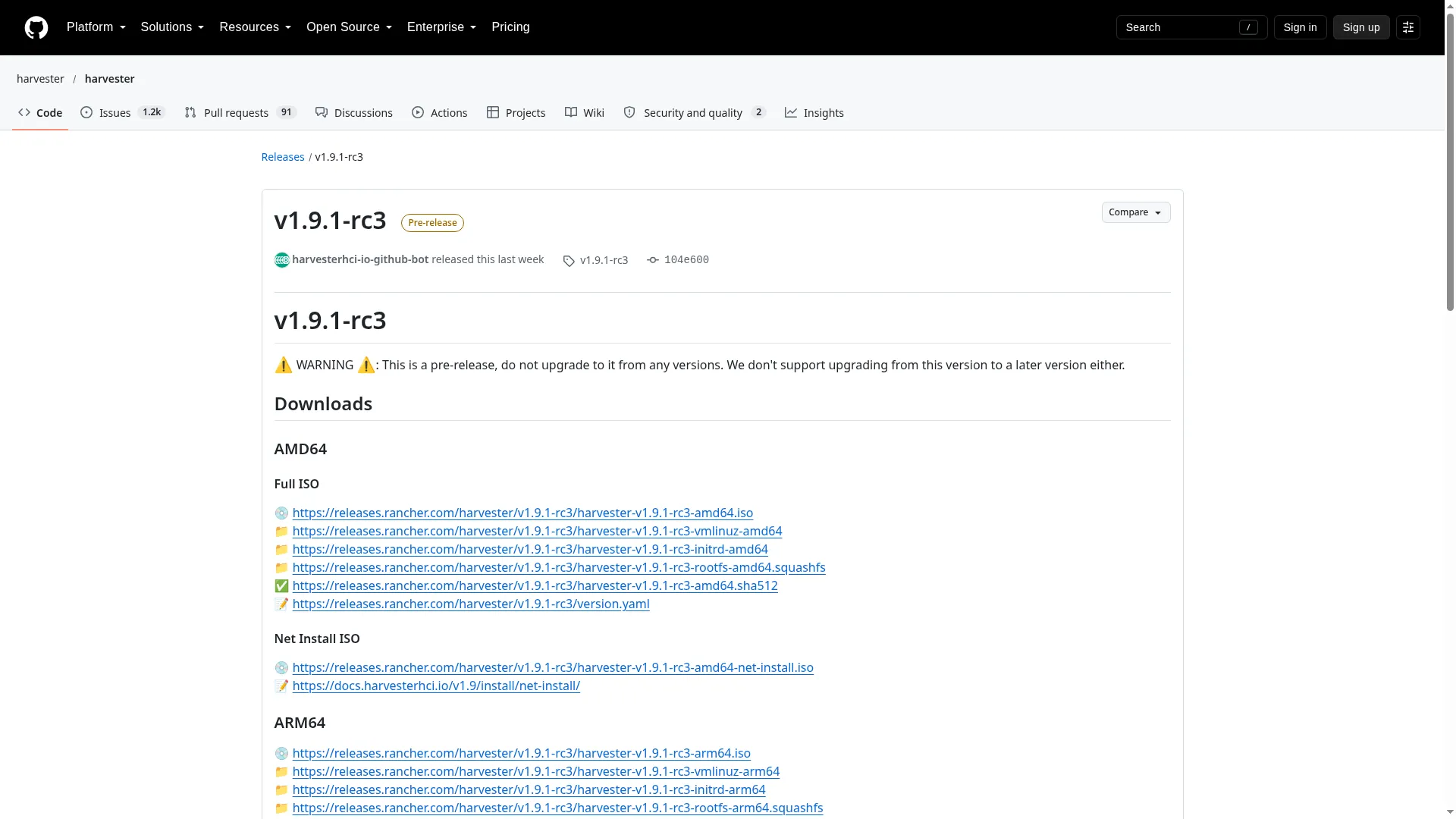 ▲ GitHub: Harvester v1.9.1-rc3 (pre-release, Oct 8); GA close but not out
KubeVirt v1.9.1 (Oct 12)
KubeVirt v1.9.1 ships 83 changes from 24 contributors. Notable fixes: Windows guests are no longer terminated immediately on crash and can finish their memory dump and reboot; guests can no longer eject critical PCI devices (disks, balloon, RNG, watchdog) via “Safely Remove Hardware”; live-migration domain stats collection now uses NOWAIT to avoid blocking up to 30 seconds on the libvirt job lock; the Vera Rubin GPU (10de:3041) is recognized as a Grace GPU.
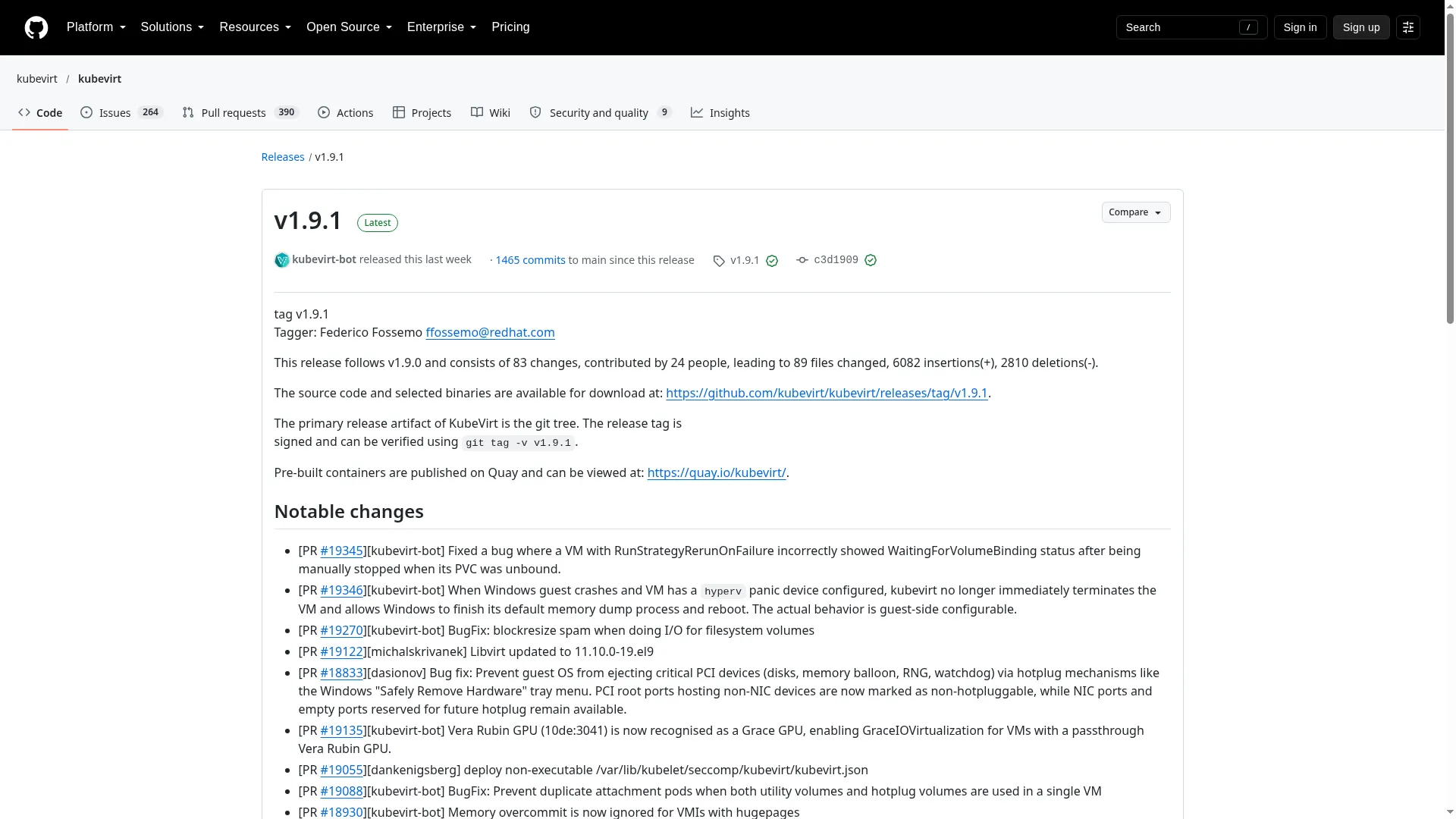 ▲ GitHub: KubeVirt v1.9.1 (Oct 12), 83 changes
Quick hits
- libvirt 12.8.0 (Oct 1): resctrl whole-process allocation and monitoring; new
auto_dump_max_sizeqemu.conf setting to cap auto-triggered dump sizes; VLAN configuration on FreeBSD bridges. - Talos 1.14.3 / 1.14.4 (Oct 15, Oct 16): see the headline section.
3. Cloud providers
Azure NVv4 series retired (Sept 30)
Microsoft Azure retired the NVv4 GPU VM series on September 30 (Standard_NV4as_v4 / NV4ahs_v4 / NV8as_v4 / NV8ahs_v4 / NV16as_v4 / NV16ahs_v4 / NV32as_v4 / NV32ahs_v4). Remaining VMs are set to a deallocated state — they stop working, stop billing, and lose SLA coverage. Microsoft’s recommended target is the NVadsA10_v5 series (higher GPU memory bandwidth per GPU, GRID license included, usable as a virtual workstation for up to 25 concurrent users); latency-insensitive offline inference can consider NCasT4_v3. One- and three-year RI purchases ended November 2, 2025; CPP sales ended June 2, 2026.
Heads-up: a known resize error affects migrations from NVv4 to the NVads_V710_v5 series. Register your subscription for the AFEC flag VMTempDiskResizePreview and confirm registration before resizing.
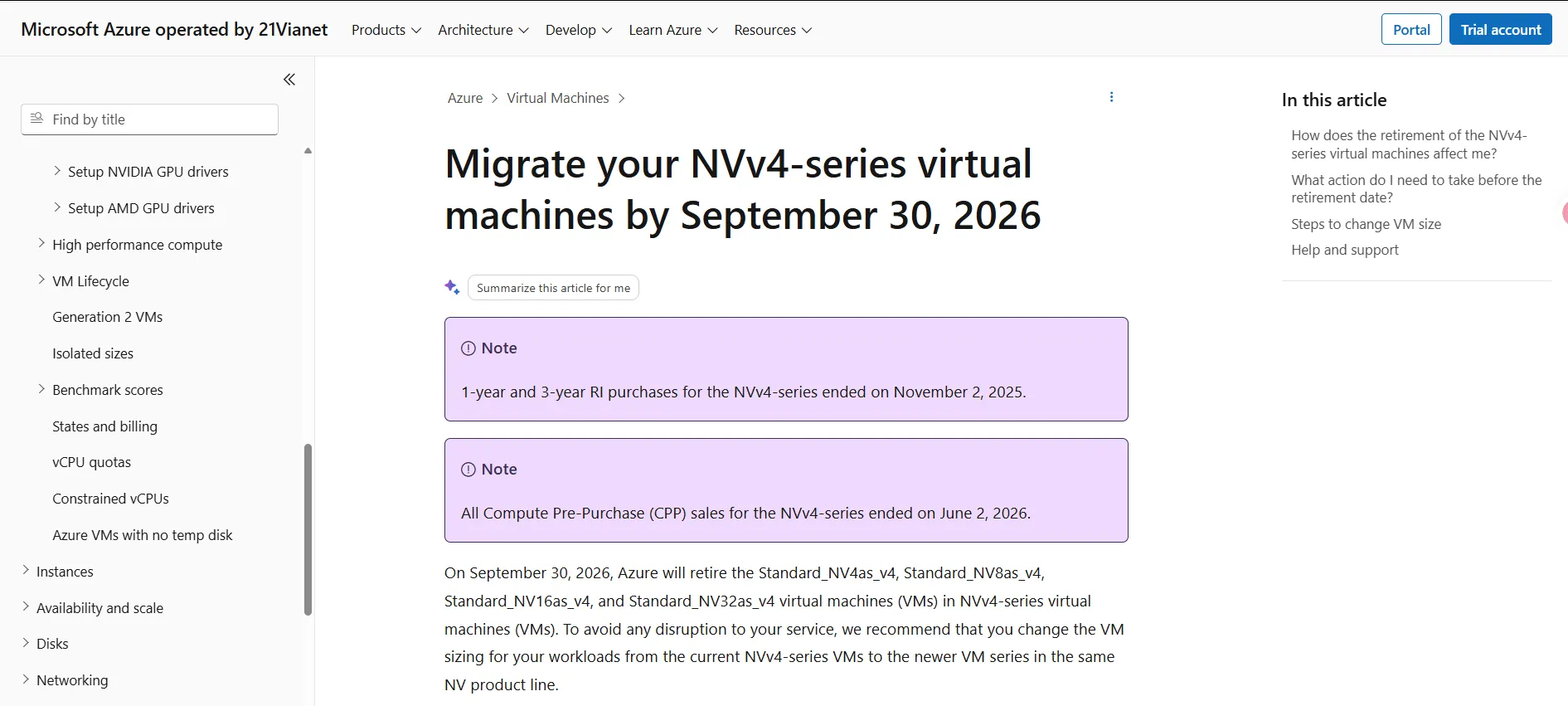 ▲ Microsoft Learn: “Migrate your NVv4-series virtual machines by September 30, 2026”
4. Security advisories
XSA-520: Xen grant-table cache-flush page reference leak (Oct 13)
On October 13 the Xen Project published XSA-520 (CVE-2026-102700): in GNTTAB_cache_flush handling, the NULL-check added by the earlier XSA-232 fix never had its error path adjusted, so pages owned by special system domains (DOM_IO/DOM_COW) leak a reference. The likely outcome is denial of service of Domain 0 (and thereby the host) or of another domain. Xen 4.5 through 4.20 on x86 are affected; 4.21+ and 4.4- are not, and Arm is not vulnerable. There is no mitigation; xsa520.patch applies to the 4.17.x–4.20.x stable branches. Credit: Andrew Cooper (Citrix) and Yehyeong Lee, independently.
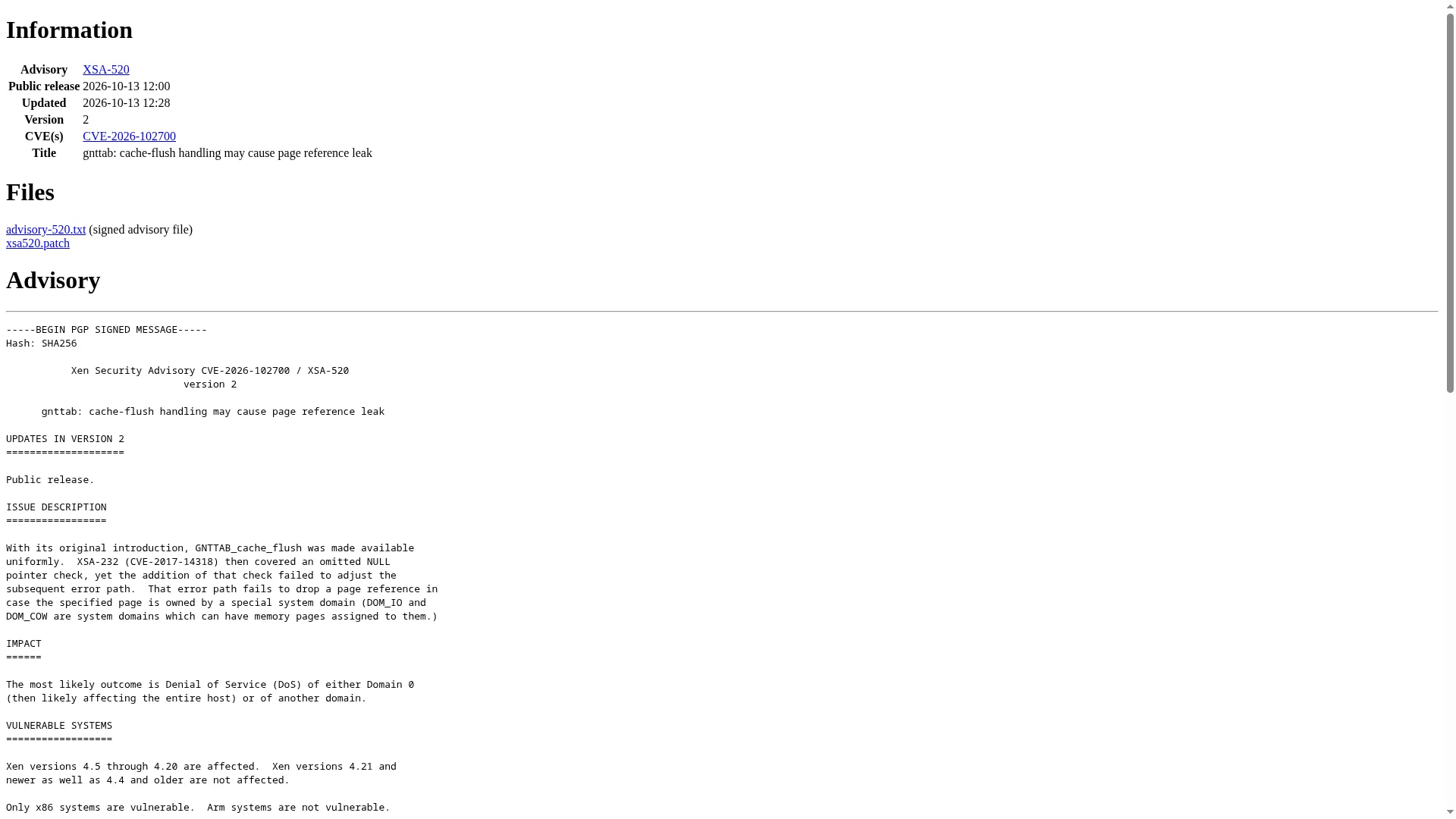 ▲ xenbits.xen.org: XSA-520 publicly released 2026-10-13
Desktop-hypervisor patching reminder: VMSA-2026-0007 (Canada’s Cyber Centre relayed Oct 7)
The Canadian Centre for Cyber Security issued AV26-1008 on October 7, urging users to act on Broadcom’s VMSA-2026-0007 (initially published in early September): a VMXNET3 integer overflow (CVE-2026-59346, CVSS 9.3 — a local admin inside a VM can execute code on the host) and an HGFS stack buffer overflow (CVE-2026-59347, CVSS 8.1) in VMware Workstation and Fusion. Fixed in 26H1u1; no workarounds. If you run Workstation/Fusion 26H1 or earlier, patch now.
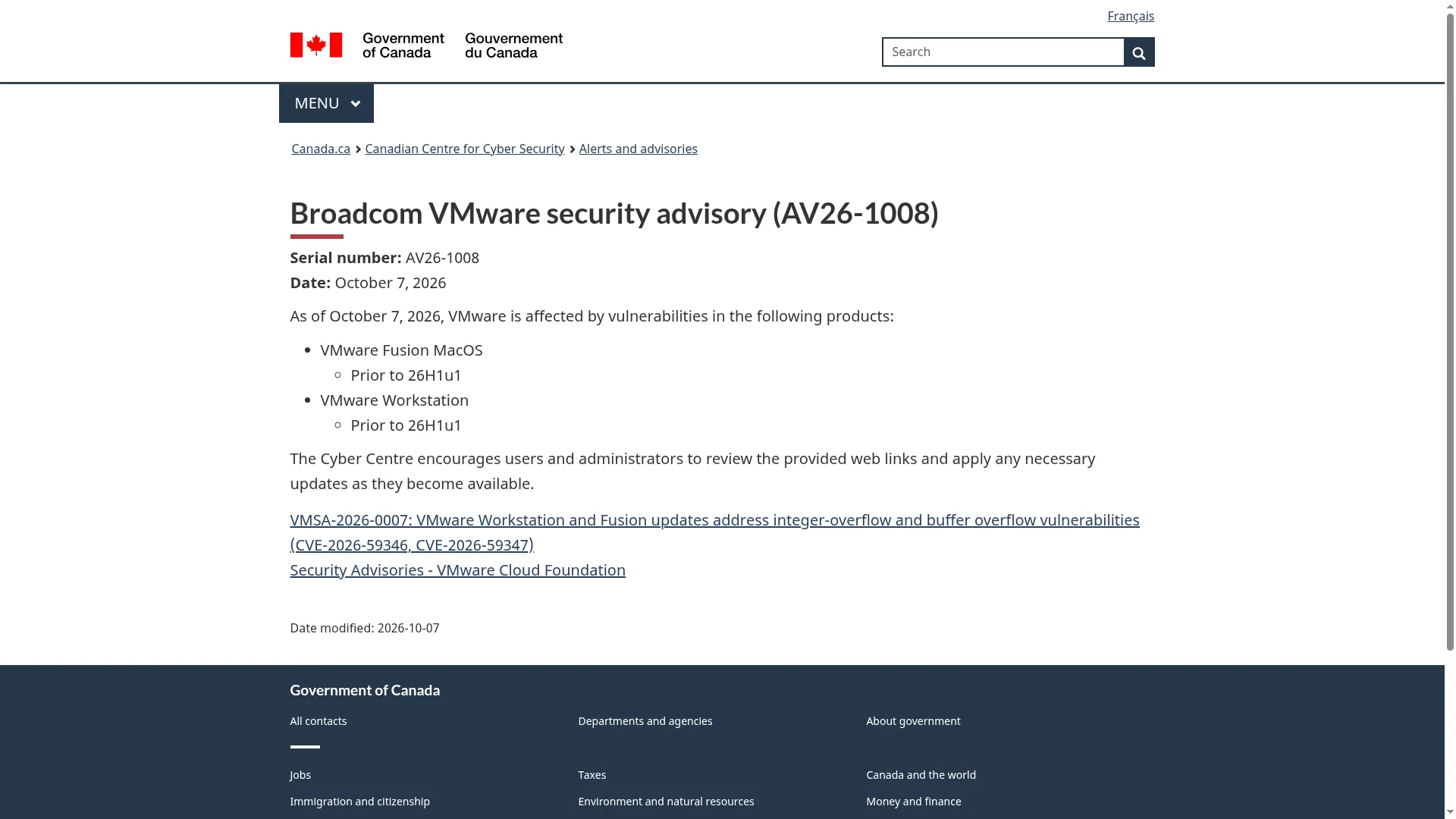 ▲ cyber.gc.ca: AV26-1008 (2026-10-07) — Fusion and Workstation prior to 26H1u1
5. Community pulse
- Frankfurt attendee discussion: attendees report thinner crowds (“the rooms weren’t as full”) and zero vSphere Standard 9 details; sentiment is cold, with comments like “VMware as a brand is done” resonating.
- Italian-language community thread “La Vita dopo VMware”: life-after-VMware migration stories — a grassroots echo of the Rimini Street survey.
6. Looking ahead
- KVM Forum 2026: November 12–13, Vancouver, Canada (Coast Coal Harbour Vancouver Hotel). The schedule is live on Pretalx; admission is $75 (free for accepted speakers), and the special hotel rate is sold out. We’ll recap the event in a coming issue.
- Microsoft Ignite: November 17–20 — watch for Azure virtualization and retirement/migration follow-ups.
- Talos Hypervisor GA: officially targeted for December 2026; hitting that date is central to the credibility of its VMware-alternative story.
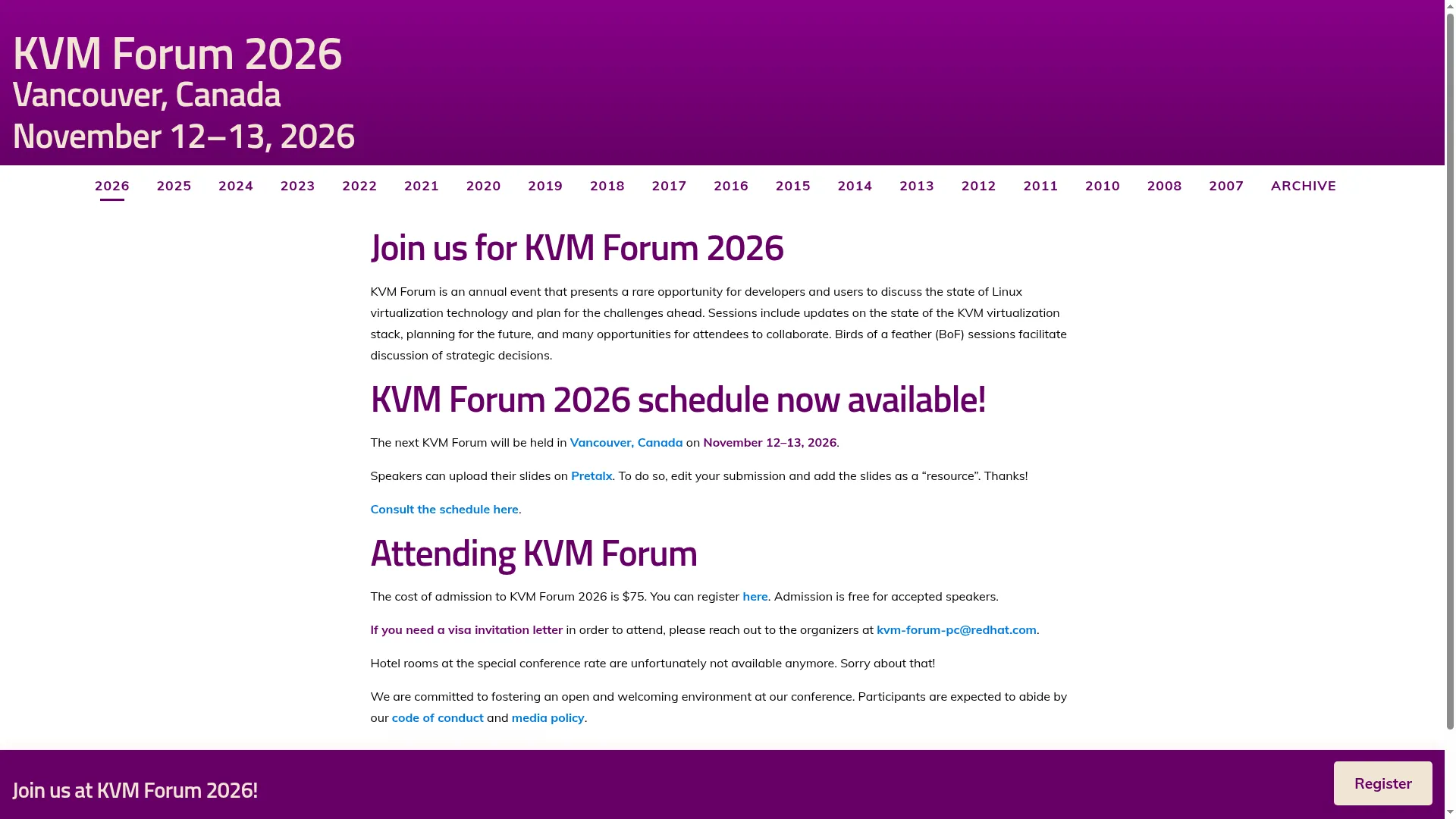 ▲ kvm-forum.qemu.org: KVM Forum 2026, November 12–13, Vancouver — schedule published
7. ZSvirt community notes
Third-party hands-on: Vladan Seget tests ZSvirt (updated Oct 15)
Veteran virtualization blogger and 17-time vExpert Vladan Seget (ESX Virtualization / vladan.fr) published a long-form hands-on review on October 15, deploying ZSvirt nested in his VMware Workstation lab. Key takeaways:
- Positioning and license: ZSvirt is the community edition of ZStack’s production-hardened ZSphere engine, open-sourced under GPL-3.0 with no limits on hosts, VMs, or features in production. A single control plane is claimed to scale to 10,000+ hosts, with Large VM support up to 768 vCPUs (vendor-stated figures).
- Deployment: ISO and OVA install media are provided. The ISO — based on a hardened Linux — offers Management Node / Compute Node / Expert Mode roles at install time. Seget likens the flow to “installing ESXi and vCenter from one single ISO”: after install you initialize datacenter → cluster → host, and the web UI ships with a default admin/password login that must be changed immediately.
- Feature set: distributed switches, port groups, security groups, and SR-IOV with live-migration support; primary storage covering local directories, NFS, iSCSI, Ceph and plugins; HA with a NeverStop mode plus granular restart policies based on management/storage/business-NIC failure combinations; the management plane itself supports dual-node HA (VIP + automatic failover).
- Ecosystem: agentless backup integration with Veeam Backup & Replication v12/v13 and Commvault 11.40.51; the ZMigrate appliance performs agentless block-level migration from vSphere, other KVM platforms and Hyper-V with cutover in as little as five minutes, plus OVF import and VMDK upload.
- Verdict: the platform is “robust, very fast, with a very polished UI (he likes it more than Proxmox’s)”; explicitly recommended for testing and POC, with the ZStack commercial edition as the supported path.
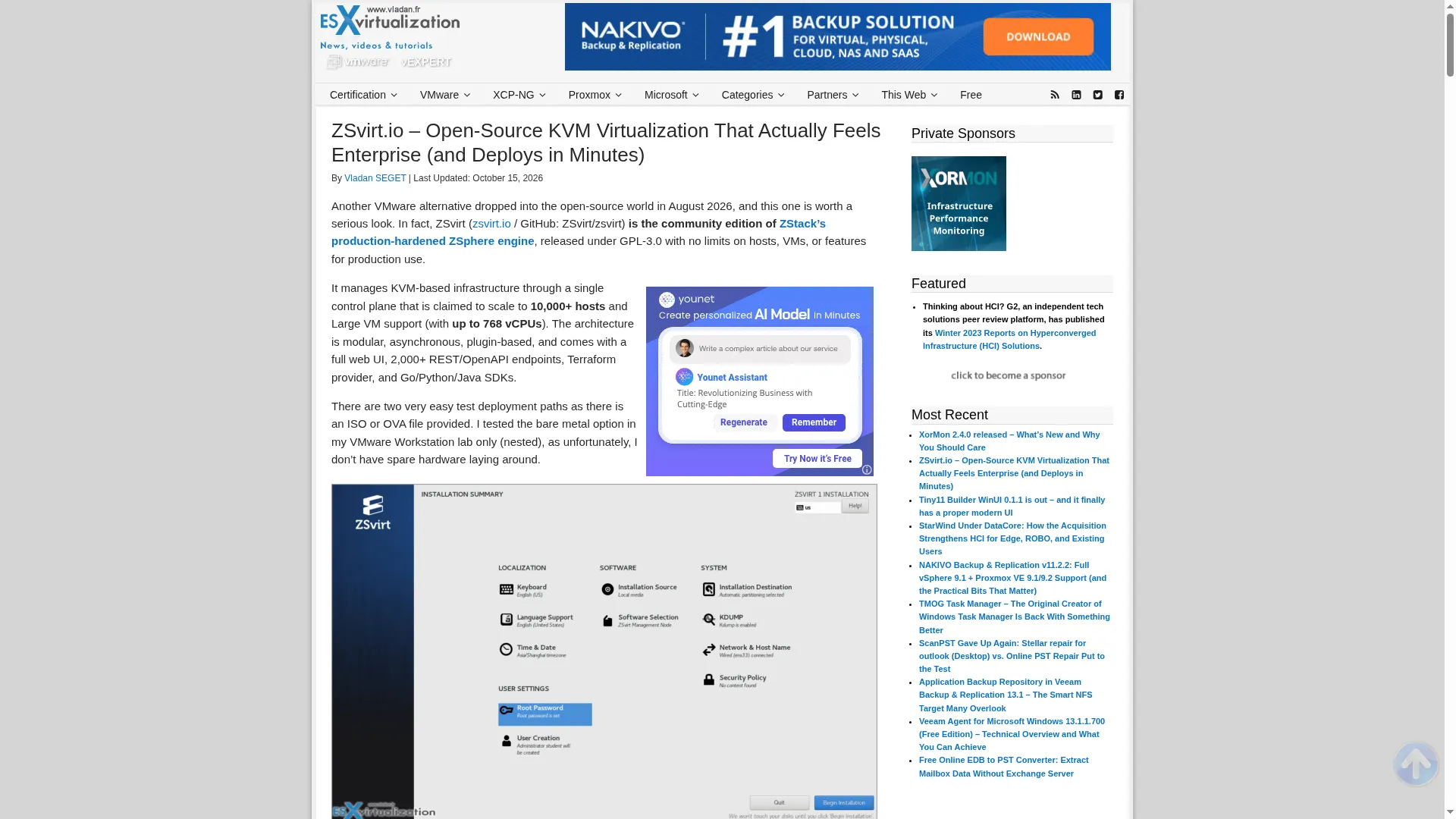 ▲ vladan.fr review: single control plane claimed at 10,000+ hosts, Large VMs up to 768 vCPUs (source screenshot, as elsewhere)
Official comparison: ZSvirt vs Proxmox VE 9 (Oct 9)
The ZSvirt team published a long-form comparison on October 9 — ZSvirt 1.0.0 (released 2026-08-12) versus Proxmox VE 9.2 (x86-64 on 2026-05-21, arm64 on 2026-08-05). Core dimensions:
- Common ground: both are KVM platforms with free HA, live migration, snapshots, backup and web management; licenses are GPL 3.0 vs AGPL 3.0.
- Day-2 operations: ZSvirt ships GUI workflows for OVF import, OVA export, bidirectional template↔VM conversion, changing a running VM’s IP, batch cloning from templates, a recycle bin, security-group binding at creation time, and a guided vNUMA wizard — on PVE most of these require the CLI or manual steps (e.g.
qm importovf, no native OVA export). PVE’s VM hibernation (qm suspend --todisk) has no ZSvirt equivalent. - Scale and scheduling: PVE’s corosync cluster state is latency-sensitive, so clusters are typically kept under ~20 nodes, with multi-cluster management layered via Proxmox Datacenter Manager (enterprise repo requires a Basic+ subscription); ZSvirt separates management and compute roles with a single control plane specified for 10,000+ hosts. PVE 9.2’s Cluster Resource Scheduling offers Basic (count-based default), Static Load and Dynamic Load modes — opt-in, and the dynamic mode only balances HA-managed guests — while ZSvirt’s DRS balances all cluster guests on live CPU/memory thresholds.
- VMware migration: PVE’s built-in ESXi import (since 8.2, tested against ESXi 6.5–8.0) cannot handle vSAN disks, encrypted disks or vTPM state; ZMigrate is agentless, with online migration subject to scale limits and offline import unlimited.
- Automation and security: the ZSvirt Community Edition exposes 2,000+ REST/OpenAPI endpoints with an official Terraform provider and Go/Python/Java SDKs, plus Secure Boot, vTPM 2.0, VM encryption, security-group micro-segmentation and immutable audit logs.
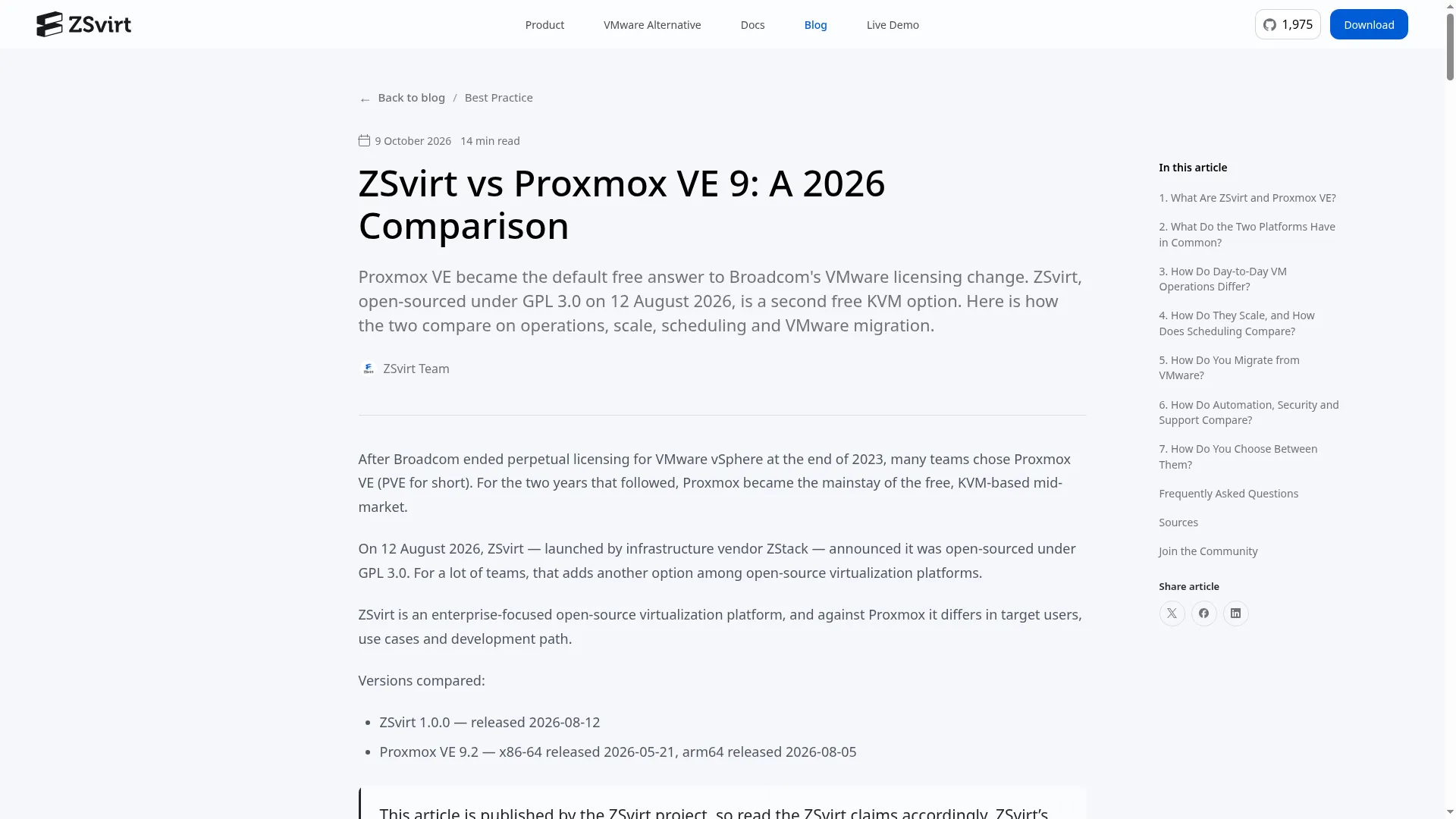 ▲ ZSvirt blog: GPL 3.0-licensed ZSvirt 1.0.0 versus AGPL 3.0 Proxmox VE 9.2
Editor’s note: worth highlighting is the article’s sense of proportion — it openly discloses that it is written by the ZSvirt project, that vendor-run comparisons are “a starting point, not independent verification,” and urges readers to reproduce what matters in their own labs. That self-disclosure is uncommon in vendor comparisons and deserves credit. Fittingly, the top question under Seget’s review was “how does it compare with Proxmox?” — the official comparison answers it head-on. Read together, the two pieces complement each other: independent hands-on feel plus a systematic item-by-item checklist. ZSvirt’s blog also lists VirtWatch Weekly Issue 003 in its related reading — community content is starting to cross-reference.
Community housekeeping
- Issue 004 is archived in both Chinese and English in the community repository under
virtwatch-weekly/, in the language-specificissue-004/directory. - The video edition will be produced after the text draft passes community proofreading.
- Tips welcome: releases, advisories, war stories — selected items go into the next issue’s community section.
References
Headlines · VMware
- The Register: VMware swings its focus back to low-end server virt, promises vSphere Standard upgrade (2026-09-02) — https://www.theregister.com/virtualization/2026/09/02/vmware-swings-its-focus-back-to-low-end-server-virt-promises-vsphere-standard-upgrade-1/5294083
- heise online (English): Broadcom plans new vSphere Standard (2026-09-03) — https://www.heise.de/en/news/Broadcom-plans-new-vSphere-Standard-11440309.html
- heise online: Umfrage unter VMware-Kunden: 90 Prozent suchen nach Alternativen (2026-10-07, German) — https://www.heise.de/news/Umfrage-unter-VMware-Kunden-90-Prozent-suchen-nach-Alternativen-11479284.html
- TalosCon 2026 official site — https://www.taloscon.com/
- Sidero Labs: Talos Hypervisor product page — https://www.siderolabs.com/talos-hypervisor
- Sidero Labs blog: Introducing Talos Director (2026-09-30) — https://www.siderolabs.com/blog/introducing-talos-director
- Talos v1.14.4 release — https://github.com/siderolabs/talos/releases/tag/v1.14.4
- QEMU download page (11.1.2, 2026-09-28) — https://www.qemu.org/download/
- OpenStack Releases index (2026.2 Hibiscus, 2026-09-30) — https://releases.openstack.org/
- OpenStack Hibiscus release page — https://www.openstack.org/software/openstack-hibiscus/
- OpenStack Hibiscus cycle highlights — https://releases.openstack.org/hibiscus/highlights.html
- Harvester v1.9.1-rc3 — https://github.com/harvester/harvester/releases/tag/v1.9.1-rc3
- KubeVirt v1.9.1 — https://github.com/kubevirt/kubevirt/releases/tag/v1.9.1
- libvirt NEWS — https://libvirt.org/news.html
- Microsoft Learn: NVv4 series retirement — https://learn.microsoft.com/en-us/azure/virtual-machines/sizes/lifecycle/retirement/nvv4-retirement
- Azure China docs: NVv4 系列停用 — https://docs.azure.cn/zh-cn/virtual-machines/sizes/lifecycle/retirement/nvv4-retirement
- Xen XSA-520 — https://xenbits.xen.org/xsa/advisory-520.html
- Canadian Centre for Cyber Security AV26-1008 — https://www.cyber.gc.ca/en/alerts-advisories/broadcom-vmware-security-advisory-av26-1008
- Broadcom VMSA-2026-0007 — https://support.broadcom.com/web/ecx/support-content-notification/-/external/content/SecurityAdvisories/0/38288
- KVM Forum 2026 — https://kvm-forum.qemu.org/2026/
- ESX Virtualization (Vladan Seget): ZSvirt.io hands-on review (updated 2026-10-15) — https://www.vladan.fr/zsvirt-io-open-source-kvm-virtualization-that-actually-feels-enterprise-and-deploys-in-minutes/
- ZSvirt official blog: ZSvirt vs Proxmox VE 9: A 2026 Comparison (2026-10-09) — https://zsvirt.io/blog/zsvirt-vs-proxmox-ve
VirtWatch Weekly is edited by volunteers of the ZSvirt community. We strive for accuracy; corrections are welcome in the community channels. Please credit the source when reposting.