

Introduction
Due to the high cost of GPU infrastructure, particularly high-end accelerators, enterprises are increasingly focused on improving GPU utilization. A common question arises: since GPU resources are rarely fully utilized at all times, can a single GPU be partitioned and shared among multiple users—similar to how CPU virtualization enables multiple virtual machines on a physical server—to maximize resource efficiency?
However, in practice, GPU virtualization and resource sharing remain significantly less mature than CPU virtualization due to several fundamental differences, including:
-
The architectural differences between GPUs and CPUs
-
The differences in workload characteristics and usage scenarios
-
The varying levels of hardware and software ecosystem maturity across GPU vendors
This article provides an overview of GPU architecture and explores major approaches for sharing GPU resources, including vGPU, MPS, MIG, CUDA Hook, and remote invocation technologies. It also examines how enterprises can select the right GPU sharing strategy to improve utilization and efficiency in modern AI environments.
I. Overview
1.1 Overview of How GPUs Work
1.1.1 Highly Parallel Hardware Architecture
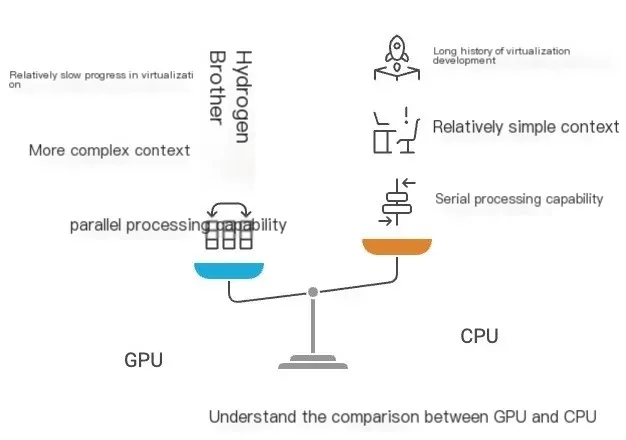
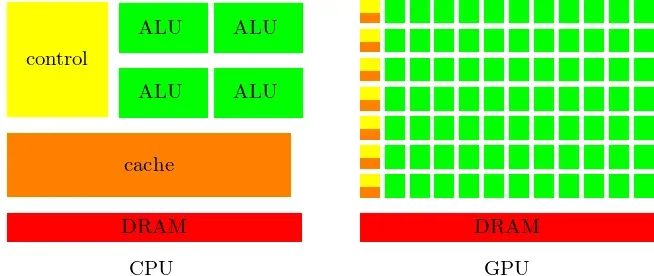
A GPU (Graphics Processing Unit) was originally designed for graphics acceleration and has evolved into a processor optimized for massively parallel computing workloads. Unlike CPUs, which are designed for general-purpose computing and complex sequential operations, GPUs contain large numbers of streaming multiprocessors (SMs) and computing cores, enabling thousands of threads to execute simultaneously under Single Instruction, Multiple Data (SIMD) or Single Instruction, Multiple Threads (SIMT) execution models.
1.1.2 Context and Video Memory (VRAM)
CUDA Context:
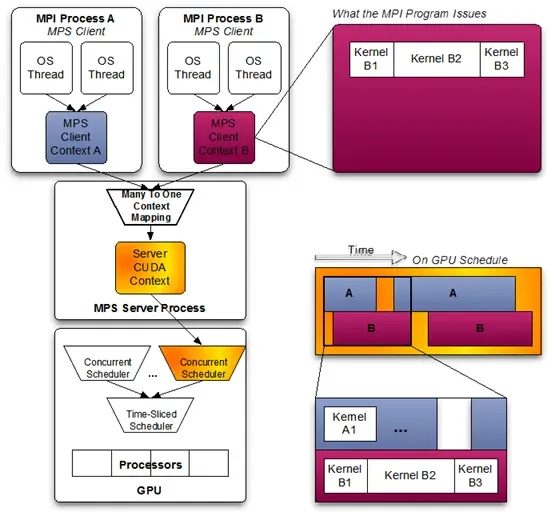
In a CUDA programming environment, when multiple processes or containers access the same GPU, each typically requires its own CUDA context. The GPU manages these contexts through time-slicing mechanisms or context-sharing approaches, such as NVIDIA Multi-Process Service (MPS), which combines multiple processes into a shared execution context.
Video Memory (VRAM):
Unlike CPU memory management, which primarily relies on operating system-level memory virtualization mechanisms such as the MMU, GPU memory management generally requires explicit allocation and management of VRAM resources.
GPU resources consist of multiple components, including compute units, memory bandwidth, and VRAM capacity, all of which must be considered when evaluating GPU utilization and sharing strategies.
1.1.3 GPU Hardware and Scheduling Mechanisms
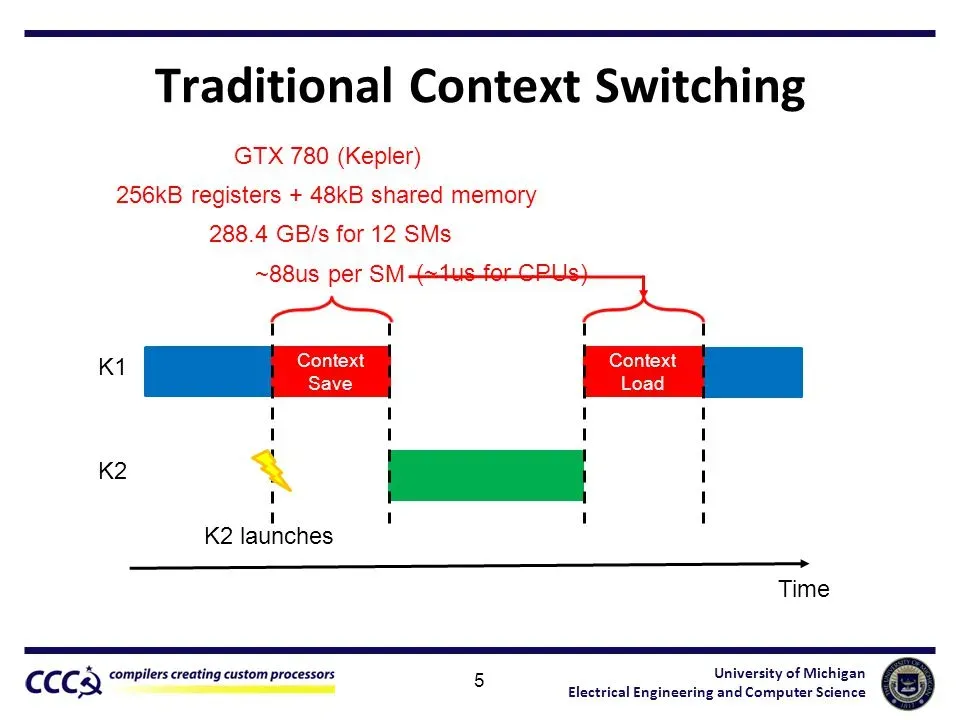
GPU context switching is considerably more complex and resource-intensive than CPU context switching. GPUs typically need to complete active kernels (GPU execution tasks) before switching workloads, while saving and restoring execution states introduces additional overhead.
GPU resources can generally be evaluated across two primary dimensions:
-
Compute capacity (such as SM availability and processing throughput)
-
Memory capacity (including VRAM allocation and bandwidth availability)
In practical AI workloads, optimizing GPU utilization requires balancing both compute efficiency and memory consumption.
1.2 Why GPU Sharing Technology Is Less Mature Than CPU Virtualization
1.2.1 Mature CPU Virtualization with Strong Hardware Support
CPU virtualization technologies, including KVM, Xen, and VMware virtualization solutions, have evolved over several decades. Modern CPUs provide extensive hardware virtualization support through technologies such as Intel VT-x and AMD-V, enabling efficient resource isolation and allocation.
Additionally, CPU architectures have benefited from strong collaboration between hardware manufacturers and virtualization software providers, creating a mature and standardized ecosystem.
1.2.2 High Parallelism and Expensive GPU Context Switching
Due to the highly parallel architecture of GPUs, achieving efficient resource sharing requires managing concurrent workloads, VRAM contention, scheduling complexity, and compatibility with proprietary GPU drivers.
Unlike CPUs, where virtualization can abstract hardware resources at the instruction-set level, GPUs contain thousands of parallel execution units and specialized computing pipelines, making complete hardware-level virtualization significantly more challenging.
As a result, GPU resource sharing technologies continue to evolve through different approaches, including hardware partitioning, software-based virtualization, and workload-level scheduling.
1.2.3 Differences in Workload Requirements
CPUs are commonly shared across large-scale virtual machine and container environments, where workloads typically prioritize resource availability, isolation, and overall efficiency.
In contrast, AI workloads—including model training and inference—often prioritize maximum computational throughput, low latency, and predictable performance. GPU virtualization introduces additional scheduling overhead and resource contention challenges, which can impact Quality of Service (QoS) requirements.
1.2.4 Differences Across GPU Vendor Ecosystems
CPU markets are relatively consolidated, with x86 architectures from Intel and AMD dominating global enterprise environments, alongside emerging architectures such as ARM and other instruction sets.
The GPU ecosystem is significantly more fragmented, involving multiple technology stacks, including CUDA, CUDA-compatible platforms, ROCm, and proprietary acceleration ecosystems such as CANN.
This diversity creates additional challenges for achieving universal GPU virtualization standards and cross-platform compatibility.
In summary, the differences in hardware architecture, workload characteristics, and ecosystem maturity explain why GPU sharing technologies remain less standardized and mature compared with CPU virtualization.
II. Pros, Cons, and Use Cases of Common GPU Sharing Methods
GPU resource sharing approaches can generally be categorized into several major technologies. While implementations may differ across vendors and platforms, the underlying principles typically fall into the following categories:
-
vGPU (Virtual GPU): Hardware- or software-based GPU virtualization solutions, including NVIDIA vGPU, AMD MxGPU, and open-source approaches such as cGPU/qGPU.
-
MPS (Multi-Process Service): A process-level GPU sharing mechanism provided by NVIDIA that enables multiple workloads to share GPU execution resources.
-
MIG (Multi-Instance GPU): A hardware-level GPU partitioning technology introduced in NVIDIA Ampere and later architectures.
-
CUDA Hook: A software-based API interception approach that enables dynamic GPU resource management at the application layer.
-
Remote Invocation (such as rCUDA): A GPU access method that enables remote applications to utilize GPU resources over a network.
Comparison of Common GPU Sharing Technologies
Different GPU sharing approaches provide different levels of isolation, flexibility, performance, and deployment complexity. Enterprises should select the appropriate technology based on workload characteristics, infrastructure requirements, and operational objectives.
| Technology | Resource Isolation | Flexibility | Performance Efficiency | Best-Suited Scenarios |
|---|---|---|---|---|
| vGPU | High isolation through virtual GPU abstraction | High flexibility with configurable GPU profiles | Good performance with virtualization overhead | Virtual desktops, cloud platforms, multi-tenant GPU environments, and VM-based AI workloads |
| MPS | Limited isolation as workloads share the same GPU context | Medium flexibility for process-level sharing | High efficiency for concurrent small workloads | Multi-process inference, workload consolidation, and GPU throughput optimization |
| MIG | Very high hardware-level isolation | Limited flexibility due to predefined GPU profiles | Near-native performance for supported configurations | Enterprise AI clouds, multi-tenant environments, and workloads requiring strict isolation |
| CUDA Hook | Software-level isolation with implementation dependency | Very high customization flexibility | Potential overhead depending on interception strategy | Custom GPU scheduling, development environments, and internal resource management scenarios |
| Remote Invocation (rCUDA, etc.) | Dependent on network architecture and implementation | High deployment flexibility across distributed nodes | Limited by network latency and bandwidth constraints | Specialized distributed acceleration scenarios with relaxed latency requirements |
In general, hardware-based approaches such as MIG and official vGPU solutions provide stronger isolation and enterprise reliability, while software-based approaches such as MPS and CUDA Hook provide greater flexibility for workload optimization.
For modern AI environments, the optimal strategy often involves combining GPU virtualization technologies with workload-level scheduling and distributed computing frameworks.
2.1 vGPU
Basic Principle
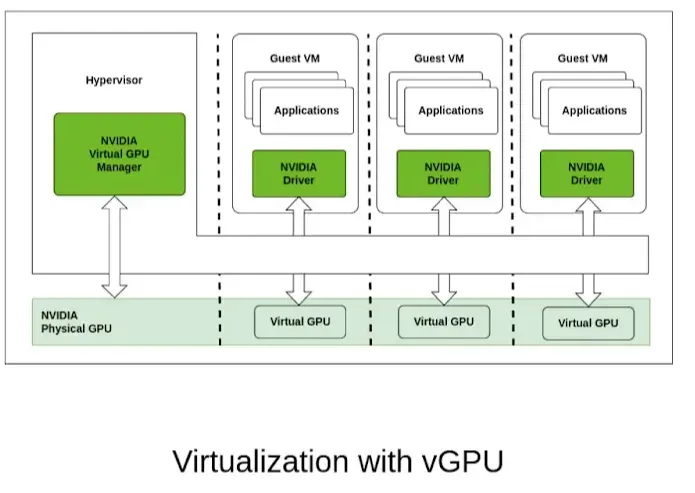
vGPU technology partitions a physical GPU into multiple virtual GPU instances through hardware-assisted, kernel-level, or user-space virtualization mechanisms.
Solutions such as NVIDIA vGPU and AMD MxGPU provide official hardware and software support, while open-source implementations such as KVMGT (Intel GVT-g), cGPU, and qGPU provide alternative approaches for GPU resource sharing.
Advantages
-
Flexible allocation of GPU compute resources and VRAM, enabling multiple virtual machines or containers to share a single physical GPU.
-
Strong ecosystem support from major hardware vendors, including mature driver management, QoS capabilities, and virtualization compatibility.
Limitations
-
Some official solutions, such as NVIDIA vGPU, primarily target virtual machine environments and may require commercial licensing, resulting in additional deployment costs.
-
Open-source solutions, including vCUDA and cGPU, may require adaptation across different CUDA versions and generally provide weaker isolation and security guarantees compared with vendor-supported solutions.
Typical Use Cases
-
Enterprises requiring GPU acceleration for virtual desktops, remote workstations, or cloud gaming environments.
-
Multi-service environments requiring GPU resource quotas, workload isolation, and improved utilization efficiency.
-
Scenarios where organizations require moderate isolation levels while balancing flexibility, compatibility, and cost considerations.
2.2 MPS (Multi-Process Service)
Basic Principle
MPS (Multi-Process Service) is an NVIDIA-provided GPU workload sharing mechanism designed for Volta and later GPU architectures.
Multiple processes act as MPS clients and submit workloads through the MPS daemon, which combines execution requests into a unified GPU context and enables more efficient resource scheduling.
Advantages
-
Improved GPU utilization and performance efficiency: Multiple workloads can execute concurrently at a fine-grained level, reducing frequent CUDA context switching overhead. This makes MPS suitable for small-scale inference workloads and multi-process training scenarios.
-
Strong CUDA ecosystem compatibility: MPS relies on official NVIDIA drivers, providing better compatibility with existing CUDA applications and frameworks.
Limitations
-
Limited fault isolation: Since multiple processes share the same execution context, failures within the MPS environment may affect other workloads running on the same GPU.
-
No hardware-level VRAM isolation: Additional scheduling and resource management mechanisms are required to prevent excessive memory consumption from impacting other processes.
Typical Use Cases
-
High-throughput inference scenarios involving multiple small AI workloads.
-
Environments requiring efficient consolidation of multiple GPU tasks onto a single accelerator while maintaining acceptable performance.
2.3 MIG (Multi-Instance GPU)
Basic Principle
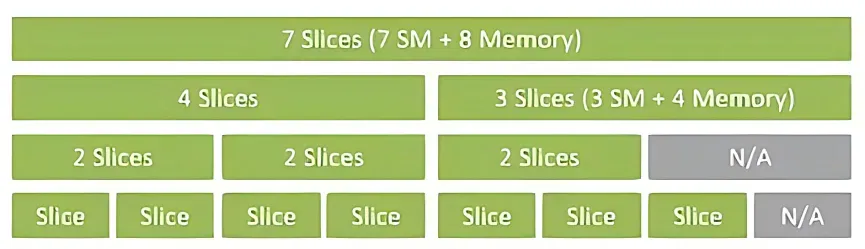
MIG (Multi-Instance GPU) is a hardware-level GPU partitioning technology introduced in NVIDIA Ampere architectures, including A100 and H100 GPUs.
MIG enables a single GPU to be divided into multiple isolated GPU instances by partitioning GPU compute resources, memory resources, and cache structures. An A100 GPU can be divided into up to seven independent GPU instances, each with dedicated hardware resources.
Advantages
-
Strong hardware-level isolation: Compute resources, memory bandwidth, and VRAM are isolated between instances, preventing workload interference and improving reliability.
-
No additional software API interception or external licensing requirements: MIG functionality is integrated directly into supported NVIDIA GPU hardware.
Limitations
-
Limited flexibility: MIG provides predefined GPU profiles, such as 1g.5gb, 2g.10gb, and 3g.20gb, resulting in relatively fixed resource allocation granularity.
-
Limited hardware availability: MIG support is restricted to specific NVIDIA GPU generations, including A100, H100, A30, and A16 platforms.
Typical Use Cases
-
High-performance computing and cloud environments requiring multi-tenant GPU workloads with strong isolation guarantees.
-
Organizations sharing high-end GPU servers where multiple users require dedicated portions of GPU compute capacity without workload interference.
2.4 CUDA Hook (API Interception)
Basic Principle
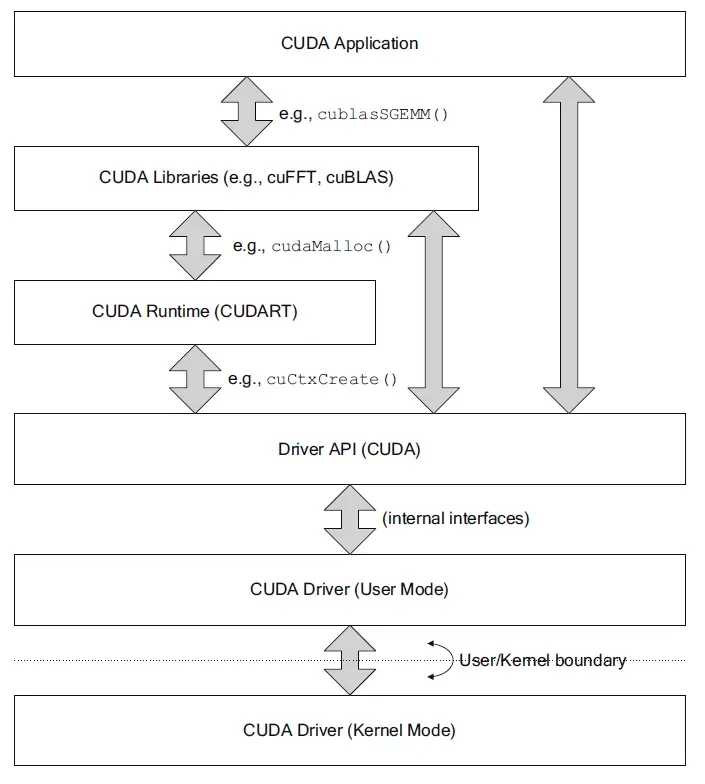
CUDA Hook is a software-based approach that intercepts CUDA runtime or driver API calls to monitor and manage GPU resource usage.
By capturing operations such as VRAM allocation and kernel submission, CUDA Hook can implement resource quotas, workload scheduling, usage monitoring, and dynamic GPU allocation policies through user-space mechanisms.
Advantages
-
Lower implementation complexity: CUDA Hook does not require significant kernel modifications or dedicated hardware virtualization support, allowing deployment across a wider range of existing GPU platforms.
-
Flexible resource management: Enables customized GPU scheduling strategies, including workload throttling, usage monitoring, and resource quota management.
Limitations
-
Potential performance overhead: Since GPU operations pass through an additional interception layer, improper implementation may introduce scheduling delays or execution overhead.
-
Limited suitability for large-scale training workloads: Frequent API interception and monitoring may reduce efficiency in highly intensive distributed AI training scenarios.
Typical Use Cases
-
Internal enterprise environments requiring flexible GPU sharing for development, testing, and small-scale AI workloads.
-
Scenarios where organizations need rapid GPU resource partitioning without requiring specialized hardware support.
2.5 Remote Invocation (e.g., rCUDA)
Concept
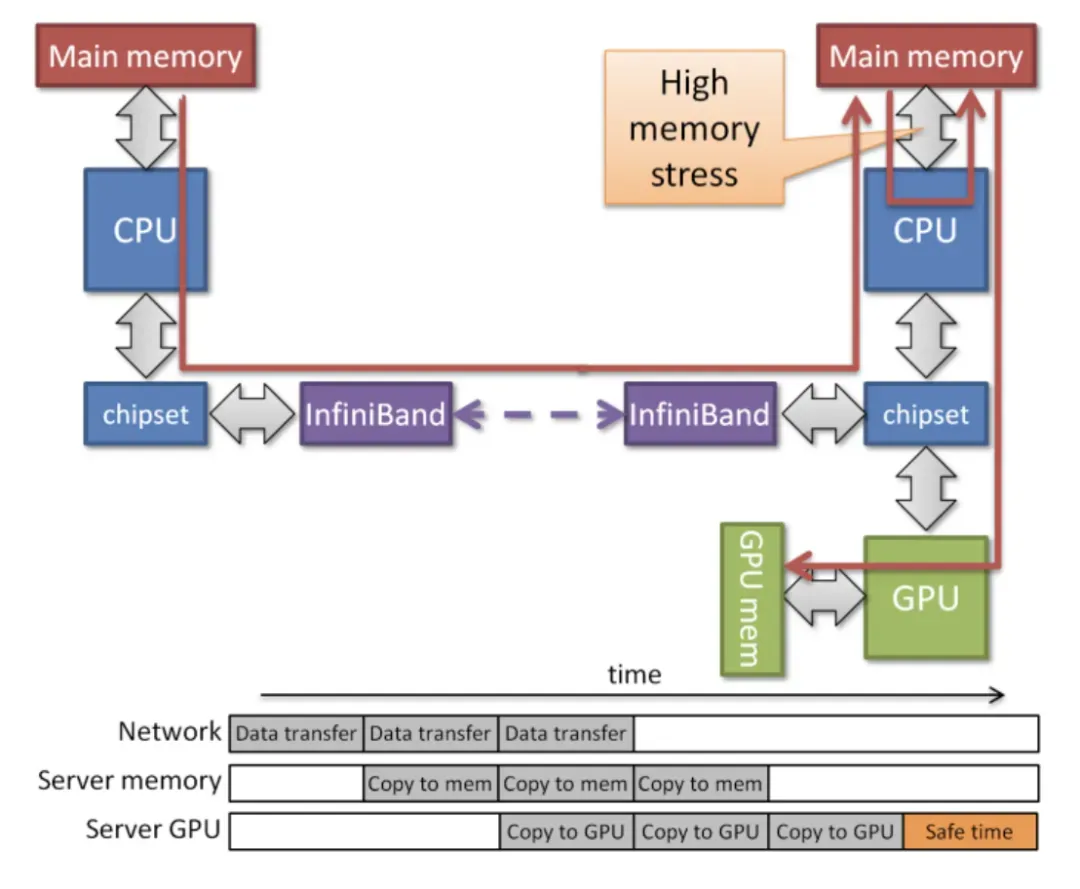
Remote invocation technologies such as rCUDA and VGL provide GPU API remoting capabilities, allowing applications running on GPU-less nodes to send GPU operations to remote GPU servers through network communication.
This approach enables GPU resource pooling across distributed environments.
Advantages
-
Enables GPU acceleration for compute nodes without locally installed GPUs.
-
Provides a conceptual approach for centralized GPU resource sharing across multiple servers.
Limitations
- Network bandwidth and latency become major performance constraints, particularly for high-throughput AI workloads.
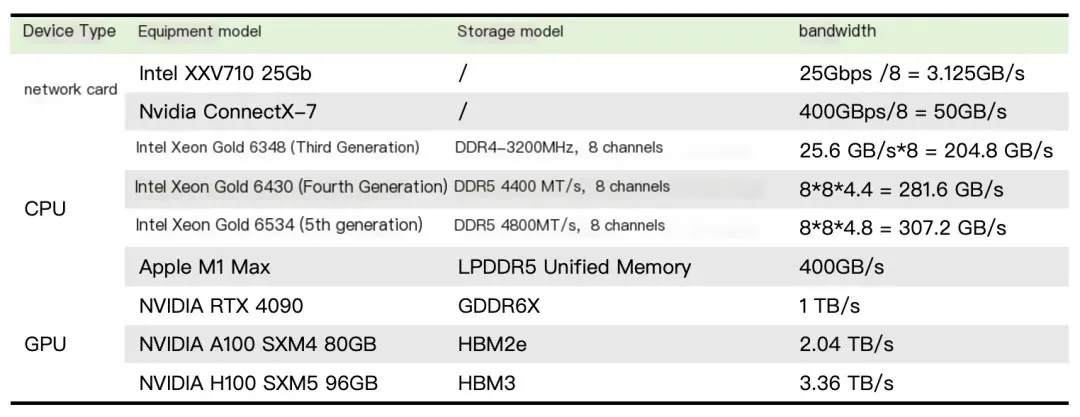
- Additional data serialization, transmission, and execution conversion overhead may significantly reduce efficiency in latency-sensitive scenarios.
Typical Use Cases
-
Distributed environments with small-scale, latency-tolerant workloads.
-
Scenarios involving limited GPU requirements, such as lightweight inference or occasional acceleration tasks.
For large-scale AI training and real-time inference workloads, remote invocation is generally not recommended due to performance limitations.
III. Model-Level “Sharing” vs. GPU Slicing
With the rapid development of large language models (LLMs), including Qwen, Llama, and DeepSeek, model sizes, parameter counts, and VRAM requirements continue to grow. A single GPU or even a single server often cannot provide sufficient memory capacity or computing resources for large-scale training and inference workloads.
As a result, AI infrastructure has evolved toward model-level resource distribution approaches, including:
-
Tensor Parallelism
-
Pipeline Parallelism
-
Expert Parallelism
-
Zero Redundancy Optimizer (ZeRO)
-
Advanced VRAM optimization techniques in distributed training frameworks
-
GPU partitioning for multi-user inference workloads
When deploying large-scale AI models, workloads are commonly distributed across multiple GPUs or servers to leverage combined memory capacity and computing power.
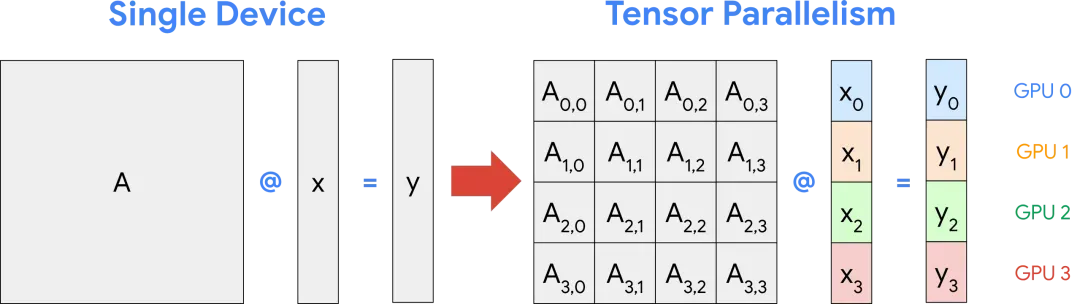
In this scenario, model parallelism becomes a higher-level form of GPU resource coordination, where distributed frameworks manage multiple accelerators as a unified computing system.
Compared with traditional GPU slicing methods such as vGPU, MIG, or MPS:
-
Large AI models often require aggregation of multiple GPUs rather than partitioning a single GPU.
-
When VRAM capacity is insufficient, dividing one GPU into smaller instances does not solve the fundamental memory limitation.
-
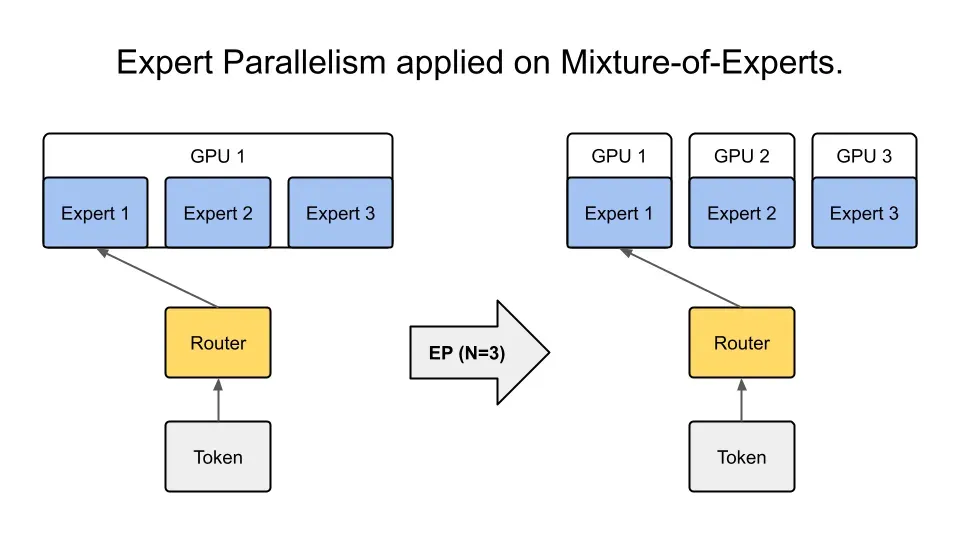
In Mixture-of-Experts (MoE) architectures, maximizing throughput depends more on efficient workload routing, GPU scheduling, and high-speed interconnect technologies rather than simply partitioning GPU resources.
3.1 When to Use Model Parallelism vs. GPU Virtualization
3.1.1 Ultra-Large Model Scenarios
When a single GPU cannot provide sufficient VRAM capacity for a model, organizations must adopt multi-GPU or multi-node distributed computing strategies.
In these scenarios, GPU slicing becomes less relevant because the objective is not to divide one GPU among multiple workloads, but rather to combine multiple GPUs to support execution of a larger model.
3.1.2 Mature AI Training and Inference Applications
For production-grade LLM training and inference environments, distributed execution frameworks, multi-GPU scheduling, and batch optimization strategies are typically already established.
In such scenarios, introducing additional GPU virtualization layers may increase operational complexity and introduce performance overhead.
Therefore, enterprises often prioritize:
-
Direct GPU access
-
Distributed parallel execution
-
Optimized GPU communication frameworks
-
High-speed GPU interconnect technologies
to achieve maximum throughput and efficiency.
3.1.3 Small Models and Development/Test Environments
For development, testing, small-model inference, or low-batch workloads, GPU virtualization and sharing technologies can significantly improve utilization.
For example, a high-end GPU may only consume a small portion of its available compute capacity or VRAM when running:
-
Embedding models
-
Reranking models
-
Lightweight inference services
-
Development workloads
In these cases, GPU partitioning methods such as MIG, vGPU, MPS, or CUDA Hook can improve resource efficiency by enabling multiple workloads to share a single accelerator.
3.2 Should Enterprises Use Remote Invocation?
Remote invocation technologies can support specific distributed GPU sharing scenarios, but they are generally unsuitable for latency-sensitive AI workloads such as large-scale inference and model training.
In production environments, enterprises typically prefer direct GPU access or hardware/software-based GPU partitioning methods to minimize communication overhead and maintain predictable performance.
Network transmission delays, serialization overhead, and additional processing layers can significantly affect:
-
Inference latency
-
Training efficiency
-
Overall throughput
Therefore, remote GPU invocation is generally recommended only for specialized scenarios with relaxed performance requirements and optimized network environments.
IV. General Recommendations and Conclusion
4.1 Large Models and High-Performance AI Applications
For large-scale AI models where single-GPU VRAM capacity is insufficient, enterprises should prioritize model-level distributed computing approaches, including:
-
Tensor Parallelism
-
Pipeline Parallelism
-
Expert Parallelism (MoE)
-
Distributed training optimization frameworks
These approaches combine multiple GPU resources at the model level, enabling higher performance while avoiding unnecessary overhead from physical GPU partitioning.
Remote invocation technologies such as rCUDA are generally not recommended for high-performance AI workloads unless deployed in specialized environments with extremely low-latency, high-bandwidth networking.
4.2 Small-Model Testing and Low GPU Utilization Scenarios
For virtual machines and container-based AI environments with moderate resource requirements, GPU virtualization technologies can significantly improve utilization efficiency.
Recommended approaches include:
-
MIG for high-isolation environments using supported NVIDIA GPUs such as A100 and H100.
-
Official vGPU solutions when enterprises require mature virtualization support and strong ecosystem compatibility.
-
MPS for improving throughput in multi-process inference scenarios.
-
CUDA Hook-based approaches for flexible resource allocation and customized GPU scheduling requirements.
Organizations should carefully evaluate:
-
Workload isolation requirements
-
Performance expectations
-
Licensing considerations
-
Hardware compatibility
-
Operational complexity
before selecting a GPU sharing strategy.
4.3 Remote Invocation Is Not Recommended for Large-Scale GPU Sharing
GPU virtualization through API remoting introduces additional network communication overhead and execution latency.
While it may be suitable for limited distributed acceleration scenarios, it is generally unsuitable for:
-
Large-scale AI training
-
Real-time inference services
-
High-throughput production workloads
For these environments, direct GPU access or optimized GPU partitioning approaches provide better performance and reliability.
GPU Resource Management in Modern AI Infrastructure
As enterprises accelerate AI adoption, efficient GPU resource management has become a critical capability for building scalable AI infrastructure.
Beyond individual GPU sharing technologies, organizations increasingly require a unified infrastructure platform capable of managing:
-
Heterogeneous GPU resources
-
AI workloads across virtual machines and containers
-
Dynamic resource allocation and scheduling
-
High-performance computing environments
-
Multi-tenant AI service delivery
A modern AI infrastructure platform should provide not only GPU virtualization capabilities but also comprehensive resource orchestration, monitoring, and lifecycle management.
ZSvirt and the ZStack cloud infrastructure ecosystem are designed to help enterprises build flexible AI-ready environments by enabling:
-
Unified management of compute, storage, and network resources
-
Flexible integration with GPU-accelerated workloads
-
Efficient resource allocation across different application scenarios
-
Simplified operations management for enterprise AI infrastructure
By combining GPU resource optimization with cloud infrastructure management capabilities, enterprises can maximize accelerator utilization while maintaining scalability, reliability, and operational efficiency.
V. Summary
The architectural characteristics of GPUs determine that GPU sharing remains more complex than traditional CPU virtualization. Challenges including highly parallel execution models, expensive context switching, VRAM management, and fragmented vendor ecosystems continue to influence the development of GPU virtualization technologies.
Different GPU sharing approaches serve different application requirements:
For ultra-large AI models and production-scale workloads:
When models require massive VRAM capacity and distributed computing resources, enterprises should rely on multi-GPU and multi-node parallel computing strategies, such as tensor parallelism, pipeline parallelism, and expert parallelism.
In these scenarios, the objective is not to divide individual GPUs but to combine multiple accelerators into a unified computing environment.
For small models, testing environments, and multi-user AI services:
GPU virtualization and sharing technologies can significantly improve accelerator utilization.
Technology selection depends on specific requirements:
-
MIG provides strong hardware-level isolation but limited flexibility.
-
Official vGPU solutions provide mature virtualization capabilities with broader enterprise support.
-
MPS improves workload concurrency and throughput but provides limited isolation.
-
CUDA Hook offers flexible resource management with greater customization requirements.
For remote invocation technologies:
API remoting can support specific distributed GPU access scenarios but is generally unsuitable for performance-critical AI workloads due to network overhead and latency limitations.
Ultimately, as AI workloads continue to evolve, the optimal GPU resource strategy depends on workload characteristics, performance requirements, and operational objectives.
For large-scale LLMs, distributed model parallelism remains the preferred approach for maximizing GPU efficiency.
For smaller AI workloads and shared development environments, GPU virtualization and resource partitioning provide an effective method to improve utilization and maximize infrastructure efficiency.
By selecting the appropriate GPU sharing strategy, enterprises can achieve better accelerator utilization, optimize infrastructure investment, and build more efficient AI computing environments.